A favourite pastime of online atheists and Christian apologists is to argue about who is responsible for most deaths, Christians or atheists. We atheists cite the crusades, forced conversions, religious wars and witch hunts, while Christians respond with Hitler, Mussolini, Lenin and Stalin.
Atheists frequently retort that Hitler was a Christian and that Lenin and Stalin’s followers committed their murders in the name of communism, not atheism, so they don’t count. It is not unusual to find an online atheist who will say that nobody has ever been killed in the name of atheism.
The purpose of this post is to refute that claim. A lot of people have been killed in the name of atheism. In saying this, I do not claim that atheism is inherently intolerant or murderous. I am an atheist myself and try to be tolerant. I have never killed anyone and, unless something goes terribly wrong when I am driving my car, I am extremely unlikely to do so.
I have two main motives for writing this article. The first is simply to put the record straight. We atheists should base our arguments on what is true, not on what we would like to be true – we should leave that to conservative Christians.
My second motive is a fear of atheist intolerance.
It is my contention that any set of ideas is capable of hardening into an intolerant ideology and atheism is no exception (I would recommend Will Storr’s excellent book The Heretics: Adventures with the enemies of science, which includes an examination of the rigid thinking he found among people who describe themselves as sceptics). The intolerance displayed by some online atheists[i] suggests to me that we need to acknowledge the crimes committed by our own side in the past in order to make sure we do not persecute religious people in a future that we hope to dominate.
I will start by disposing of two canards: Hitler and Mussolini. After that I will look at communism and the persecution of Christians by Soviet communists before turning to attacks on Roman Catholics in Spain in the early stages of the civil war and anti-clericalism in Mexico in the 1920s.
Hitler
Hitler, despite the conflicting claims of atheists and Christians, was neither a Christian nor an atheist. Though he posed as a Catholic for political reasons, in private he made it clear that he loathed Christianity. He considered himself rational and scientific in outlook but retained a belief in something he called “Providence”.[ii]
Goebbels, who was well aware how much Hitler detested Christianity, described him in his diaries as “deeply religious”.[iii] More recently Richard Weikart has examined Hitler’s religious outlook and concluded that it is best described as pantheistic.[iv]
Mussolini
Mussolini was almost certainly a lifelong atheist. However, once he was in power, he quickly realised the advantages of an accommodation with the Roman Catholic Church. After that his atheism played no further part in his public life or the crimes of his followers.
Communism
It should go without saying that communism and atheism are not the same thing. Just as you can be an atheist without being a communist, you can be a communist without being an atheist. For example, there is evidence that some early Christians were communistic,[v] as were the Münster Anabaptists. More recently the Sandinistas owed as much to liberation theology as to Marx.
The dominant influence of Marx, however, meant that 20th century communism was, for the most part, explicitly and militantly atheist. Indeed, this is part of its attraction: I can remember being told by a Trotskyist activist that it was his atheism that had led him to socialism.
The Persecution of the Church in the Soviet Union
After they took power in 1917, the Bolsheviks were divided about whether religion would die out naturally or needed to be actively undermined and/or suppressed. What united them however was a hostility to religion in all its forms.
During the civil war (1918-21), the Bolsheviks executed more than 300 clergymen, monks and nuns. It is difficult to disentangle the motives that lay behind these killings. Were these Christians killed because they were part of a church that actively supported counter-revolutionary forces, or were they killed in an effort to wipe out Christianity?
It seems that much of the impetus for attacks on Christians did not come from the top but from the grassroots.[vi] I would have thought it would be difficult to argue that a hatred of Christianity was never a motivating factor.
During the two years after the civil war ended, the persecution of Christians intensified, and this time it was directed by the Communist Party leadership. The church was plundered for its wealth and more than 6,000 clerics were executed. Only once the Orthodox Church had been thoroughly cowed did the persecution fade; for several years the Party seems to have regarded education as the best way to undermine religion.
In 1925 the League of Militant Atheists was set up. This was an offshoot of the Communist Party, though not all its activists were Party members. The Party leadership frequently struggled to contain the enthusiasm of the League, whose aim was the complete elimination of the expression of religion in the Soviet Union.
Between 1929 and 1935 the repression of Christianity resumed but now with added ferocity. Some 95,000 clerics, monks and nuns were executed during this period and a further 100,000 met the same fate as Stalin’s purges went into overdrive in 1937-8.[vii] It was only when the Germans invaded and Stalin needed the Orthodox Church to help rally the Russian people that the murderous persecution of Christians came to an end.
It is frequently argued that these atrocities were committed in the name of communism by a paranoid regime determined to exterminate any potential threat. However, I would suggest that since these campaigns of persecution were encouraged and often led by an explicitly atheist offshoot of the Party, the League of Militant Atheists, it is disingenuous to claim that a desire to extinguish religion and promote atheism was not also a motivating factor.
Attacks on the Roman Catholic Church during the Spanish Civil War
Religion was at the heart of the left-right divide in Spain in the early 20th century. The Republic established in 1931 enshrined anti-clericalism in its constitution in an effort to break the power of a reactionary and over-mighty Roman Catholic Church. Though religious freedoms were guaranteed, the constitution restricted the Church’s property rights and shattered its hold on education.
General Franco’s attempted coup in July 1936 drew support from monarchists, fascists and right-wing Catholics. It unleashed civil war and a chaotic wave of violence in those areas where Franco’s rebels were foiled by loyalist troops and hastily organised leftist militias.
These armed mobs (because that is what they often were at the beginning) massacred many of the rebel troops they captured. They then turned their attention to landowners, business leaders, right-wing politicians and prominent Catholics, arresting and executing tens of thousands. In what has been described as the most intense persecution of Catholics in west European history,[viii] “merely to be identified as a priest…a militant Christian or member of some apostolic or pious organization, was enough for a person to be executed without trial.”[ix]
Again, it is difficult to disentangle the motives of those behind the slaughter of some 6,000 clergy and members of other religious organisations during the early months of the war. Doubtless some were motivated by fear and believed that they were killing their fascist enemies before their enemies killed them. Others will have been settling scores. But surely it is difficult to argue against the proposition that some of the killing was done by atheists who saw the war as an opportunity to purge Spain of a religion they detested.
The Persecution of the Roman Catholic Church in Mexico
A decade earlier in Mexico, attempts by anti-clerical leftists to destroy the Roman Catholic Church led to civil war, terror and counter-terror. The aftermath forms the backdrop to Graham Greene’s novel The Power and the Glory.
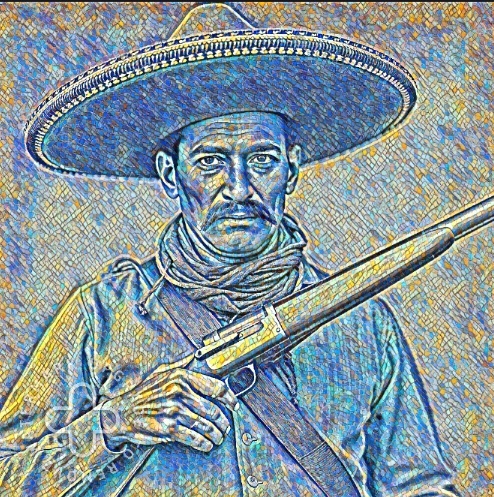
The post-revolutionary constitution of Mexico contained anti-clerical clauses but these were not enforced rigorously until the election of Plutaro Elias Calles as president in 1924. Calles was an atheist whose passionate hatred of religion led him to use the law to prevent appointments to the priesthood and requisition churches so that he could close them down. As a result, large areas of the countryside were left without a functioning church.
The resulting tensions led to a full-blown “Cristero” uprising at the beginning of 1927. In two years of Cristero terror and government counter-terror, more than 90,000 people were killed. Some of the worst atrocities on the pro-government side were committed by the Redshirts, paramilitary death squads organised by Tomas Garrido Canabal, who as governor of Tabasco would close down all the churches in his province.
Canabal was a radical left-wing atheist who boasted a farm with a bull called God, a pig called Pope, a cow called Mary and a donkey called Christ. He appears in The Power and the Glory as “the Lieutenant”. To argue that the murders committed by his Redshirts were not motivated by atheism would be perverse.
Concluding Thoughts
My aim in this post is to refute the idea that nobody has ever been killed in the name of atheism. I have focused on the Soviet Union, Spain in the early stages of the civil war and Mexico in the 1920s. I could also have written about revolutionary France during the brief heyday of the Hébertists, Eastern Europe in the late 1940s, Maoist China, Democratic Kampuchea or North Korea.
I am not suggesting that atheism is inherently intolerant or that it is worse than Christianity or Islam.[x] Indeed, I believe that fundamentalist religion is one of the most pernicious and dangerous forces at work in the world today and that we atheists need to mobilise against it. But in doing so, we should acknowledge that while atheism may be more intellectually honest than literalist religion, it does not wash away our sins or the crimes of those whose atheism has led them to persecute and kill believers in the past.

If you have enjoyed this blog post, you may enjoy my novel The Omega Course, which uses fiction to explore the origins of Christianity and the Bible. Click here for details.
Notes
[i] In a Twitter poll of atheists I came across some time ago, a majority said they would ban religion if they could. Whenever I see atheists on Twitter echo Dawkins’ description of the religious indoctrination of children as child abuse, I challenge them and say if parents abuse their children, surely those children should be taken into care, so do you favour taking the children of strongly religious parents into care? Several have told me yes, if parents refuse to stop indoctrinating their children, they should be taken into care.
[ii] Alan Bullock, Hitler: a study in tyranny third edition Pelican books 1972 pp 388-390.
[iii] 29 December 1939.
[iv] Richard Weikart, Hitler’s Religion: The Twisted Beliefs that Drove the Third Reich Regnery History 2016.
[v] Acts 4:32–35
[vi] Dimitry V. Pospielovsky, A History of Soviet Atheism in Theory, and Practice, and the Believer Vol 2, St Martin’s Press 1988, p 16
[vii] Richard Pipes, Communism: A History. Modern Library Chronicles, 2001. p. 66.
[viii] Stanley Payne Franco and Hitler: Spain, Germany, and World, Yale University Press 2008, p13
[ix] Hilari Rauger, Gunpowder and Incense: The Catholic Church and the Spanish Civil War Routledge 2012, p 126
[x] Nor am I suggesting that the Spanish Republicans were worse than Franco.


 Paul Clark
Leave a reply to notabilia Cancel reply