- Map
- Background Information
- Fact File
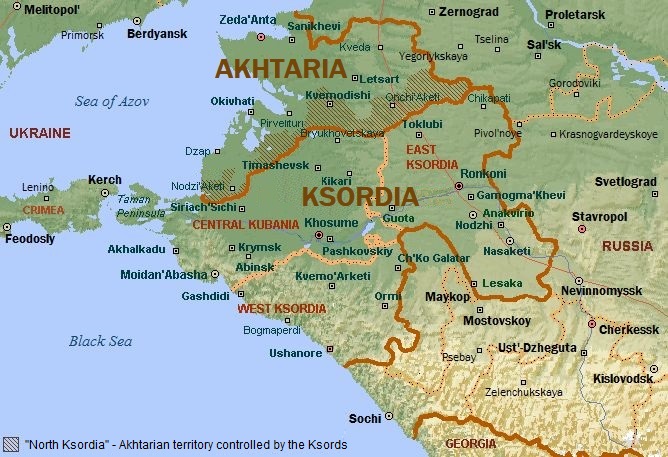
1. MAP OF KSORDIA AND AKHTARIA AT THE DECEMBER 1992 CEASEFIRE
2. BACKGROUND INFORMATION
The Ksords and Akhtarians are closely-related peoples who share a language and a culture. They were ruled by the Crimean Tatars from 1239 to 1783, when Russia conquered the region. There is a large Tatar population in Central Kubania. After the Bolshevik victory in the Russian Civil War, Ksordia-Akhtaria became a constituent republic of the Soviet Union.
In 1942, the Nazis invaded Ksordia-Akhtaria, bringing with them the Rebels, a group of Akhtarian fascist exiles, who launched a campaign of genocide against the Ksords in southern Akhtaria and Central Kubania. Stalin responded with the ‘Great Repression’: wholesale massacres of Akhtarians followed by the deportation of the entire Akhtarian nation to Soviet Central Asia. It wasn’t until 1957 that Khrushchev rehabilitated the Akhtarians and allowed them to return to their homeland.
The Rebel genocide and the Great Repression left a terrible legacy of bitterness.
When the Soviet Union collapsed at the end of 1991, Ksordia-Akhtaria became independent as a federal republic. Akhtaria was dominated by nationalists and Ksordia was increasingly dominated by Shakman Korgay, a former Communist who had reinvented himself as a hard-line nationalist.
In February 1992, Akhtaria unilaterally declared itself independent. Fighting broke out at once, but this was brought to a speedy end, thanks in large part to the mediation of Ruslan Shanidza, Ksordia-Akhtaria’s greatest ever sporting hero. Ruslan later attempted to mediate in the ethnically mixed areas of southern Akhtaria, but his peace mission was terminated when he was shot and almost killed by Ksordian extremists. The two nations fought a bloody and inconclusive war between May and December.
Meanwhile Korgay was able to consolidate his authoritarian rule in all of Ksordia, apart from Central Kubania, where the Tatar-led regional government retained its autonomy. The Central Kuban regional government pushed for independence from Ksordia and called a referendum in March 1993 to ratify it. Fearing that independence would lead to civil war, Ruslan Shanidza led a successful campaign for a No vote in the referendum. However, he knew that the fragile peace in Central Kubania couldn’t last long while Korgay ruled Ksordia, so he called upon the fractured Ksordian opposition to unite to bring him down.
3. FACT FILE
KSORDIA – Capital: Ronkoni.
Population:* 6,262,327 (71% Ksords, 8% Akhtarians, 14% Tatar, 8% other)
Ksordia is divided into four regions that are theoretically autonomous: Central Kubania, East Ksordia, North Ksordia and West Ksordia.
Central Kubania – Capital: Khosume.
Population: 1,895,266 (34% Ksords, 18% Akhtarians, 39% Tatars, 9% other)
East Ksordia – Capital: Ronkoni.
Population: 3,147,034 (87% Ksords, 5% Akhtarians, 4% Tatars, 4% other)
North Ksordia (Akhtarian territory controlled by the Ksords) – Capital: Kvemodishi.
Population: 478,000 (84% Ksords, 4% Akhtarians, 2% Tatars, 10% other)
West Ksordia – Capital: Ushanore.
Population: 742,027 (88% Ksords, 1% Akhtarians, 3% Tatars, 8% other)
*
AKHTARIA (Excluding areas controlled by the Ksords)
Capital: Zeda’Anta.
Population 1,559,000 (3% Ksords, 84% Akhtarians, 2% Tatars, 11% other)
* All population figures from the 1989 Soviet census, apart from Akhtaria and North Ksordia, which are post-war estimates.
 Paul Clark