By Paul Clark
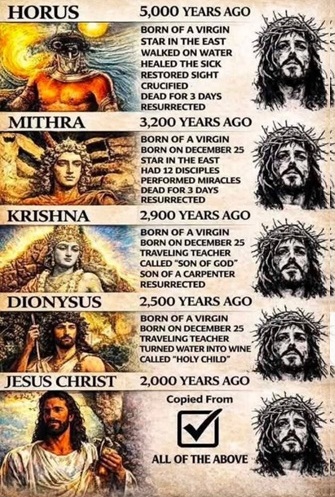
It is common on social media to find memes like the one illustrated here, which suggest that the myth of Jesus is virtually identical to a number of pagan gods. In this blog post, I will examine the claims in this meme one by one to see how accurate they are.
HORUS
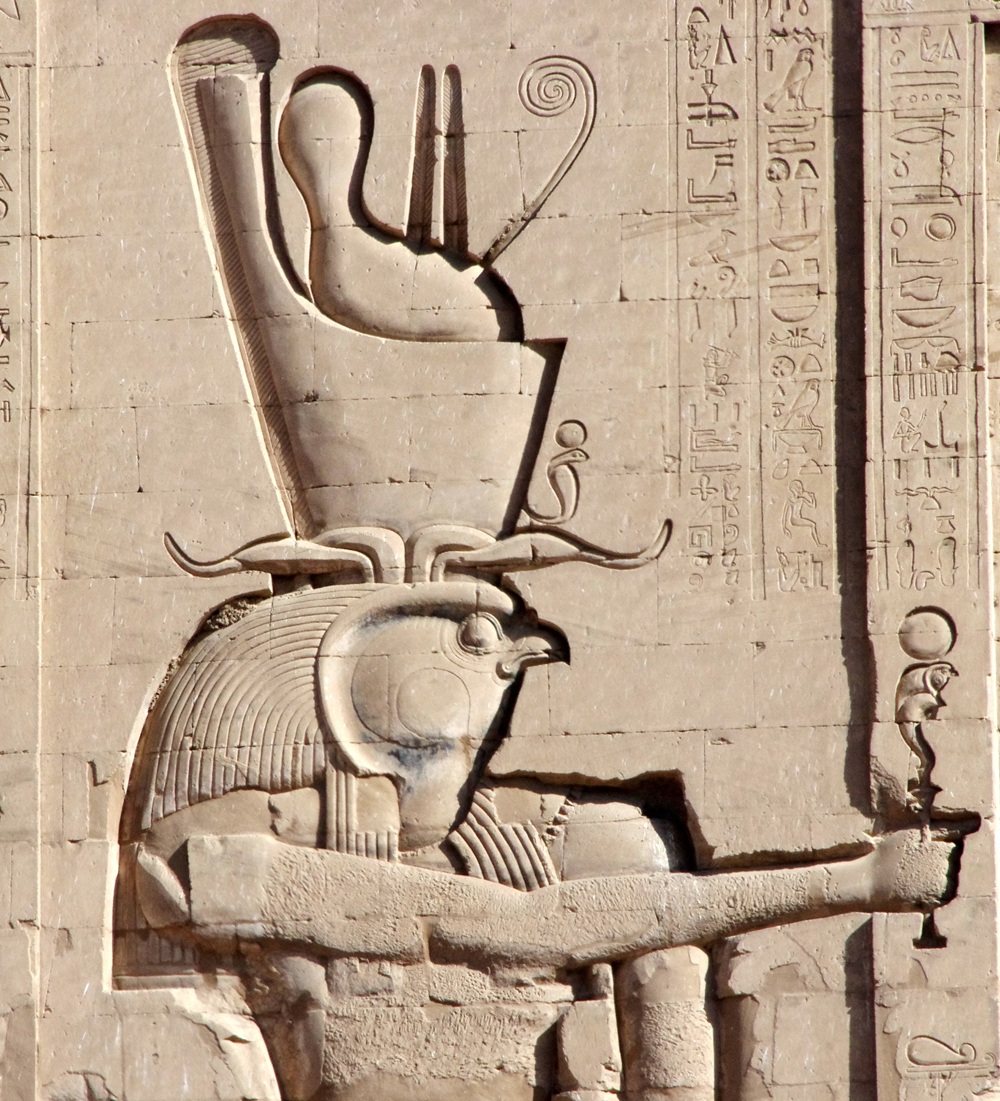
Born of a Virgin: Since Isis was married, we can assume she wasn’t a virgin. Indeed, after Osiris was murdered and dismembered, Isis found all the parts of his body except his penis and reassembled them. In order to have his child, she created a magical prosthetic penis, attached it to Osiris’ corpse and impregnated herself with it.
Star in the East / Walked on Water: There is no evidence for either of these claims.
Restored Sight: Like almost all pagan gods, Horus could be invoked to heal the sick or disabled. However, in any case where this allegedly worked, Horus would have healed at a distance from the abode of the gods. This is very different from the gospel tales of Jesus, who was generally said to heal by touch.
Crucified: There is no record of this. Indeed, the Ancient Egyptians didn’t practise crucifixion at all.
Died for Three Days / Resurrected: There is no such legend about Horus, or any story about him dying. There is one tale in which he is stung by a deadly scorpion, but Thoth, the god of healing, got off the sunboat and saved him.
MITHRAS
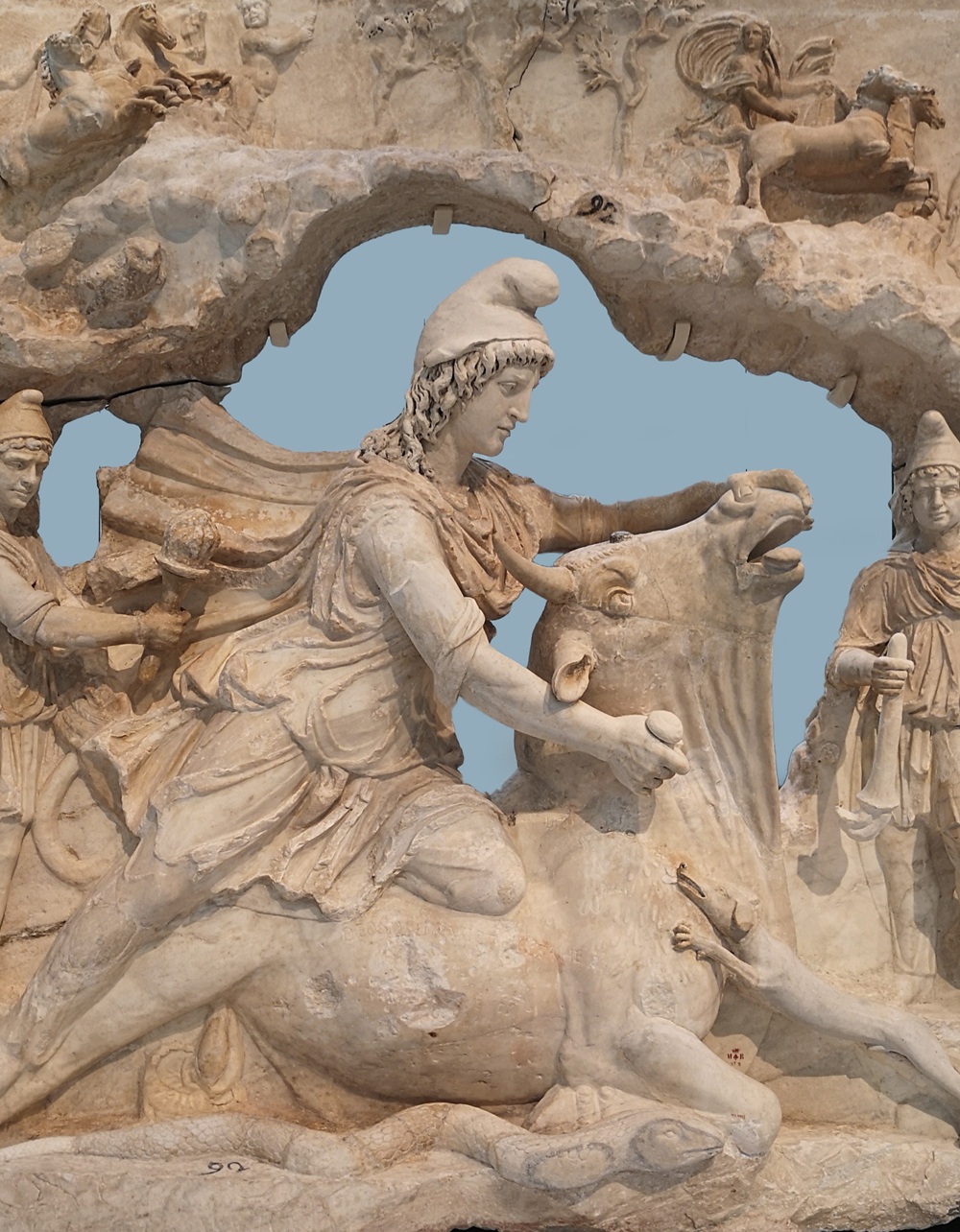
The cult of Mithras became popular among certain sections of the Roman army in the second century, but there is little evidence that it was ever widespread among the civilian population.[3]
Mithras was originally an Indian god who reached the Roman Empire via Persia. His cult was probably introduced when King Antiochus IV of Commagene was exiled to Rome in 72 CE. Apart from astrological and Persian-style images in Mithraic caves and sanctuaries, we know next to nothing about the cult as it was practised by Romans. Any knowledge of the myths behind the cult comes from Persian sources, but we have no way of knowing how relevant these are to Roman Mithraism.[iv]
Born of a Virgin: Mithras was born from a rock.[v] I suppose you could argue that the rock had never had sexual intercourse.
Born on December 25th: Writing in 1970, John Ferguson suggested that this is true. Forty years later, Hugh Bowden cast doubt on this. What we know of Mithraism suggests that its main festival was in mid-summer, and this probably celebrated the birth of Mithras as a fully-formed, knife-wielding adult who promptly slaughtered a bull.[vi]
Star in the East: Whilst astrological motifs were an important part of Mithraism, there is no evidence to suggest a star appeared in the east at the time of his birth.
12 Disciples: There is no evidence for this claim.
Miracles: Whilst claims of miracles are common to almost all religions, we have no evidence that they played an unusually important part in Mithraism.
Dead for 3 Days / Resurrected: There is no evidence of any myth in which Mithras died.
KRISHNA

Krishna is a major figure in Hinduism, one of many incarnations of the god Vishnu. In The Mahabharata, he is portrayed as a warrior, whereas the Bagavad Gita portrays him as a teacher.
Born of a Virgin: Krishna was the eighth son of Devaki, one of the wives of Vasudeva, King of the Vrishni.[vii]
Born on December 25th: He was born in the Hindu month Bhadrapada, which corresponds to late August, early September in our calendar.[viii]
Travelling Teacher: Yes, in the Bagavad Gita. However, Krishna’s message is very different from Jesus. Krishna teaches the importance of acting according to one’s duty without becoming attached to the results of your actions. He stresses duty, righteousness and spiritual growth as the keys to a fulfilling life.[ix]
In contrast, in Matthew, Mark and Luke, Jesus stressed the need to prepare for imminent arrival of the Kingdom of God. In John, his main focus was his status as the Son of God and faith in him as the route to eternal life. Most historians regard Matthew, Mark and Luke’s version of his message as more authentic.[x]
Called the Son of God: No. Krishna was an incarnation of Vishnu, not his son.
Son of a Carpenter: His father was a king.
Resurrected: No. When Krishna died, he didn’t return to earth but resumed his role in the heavens as Vishnu.
DIONYSUS
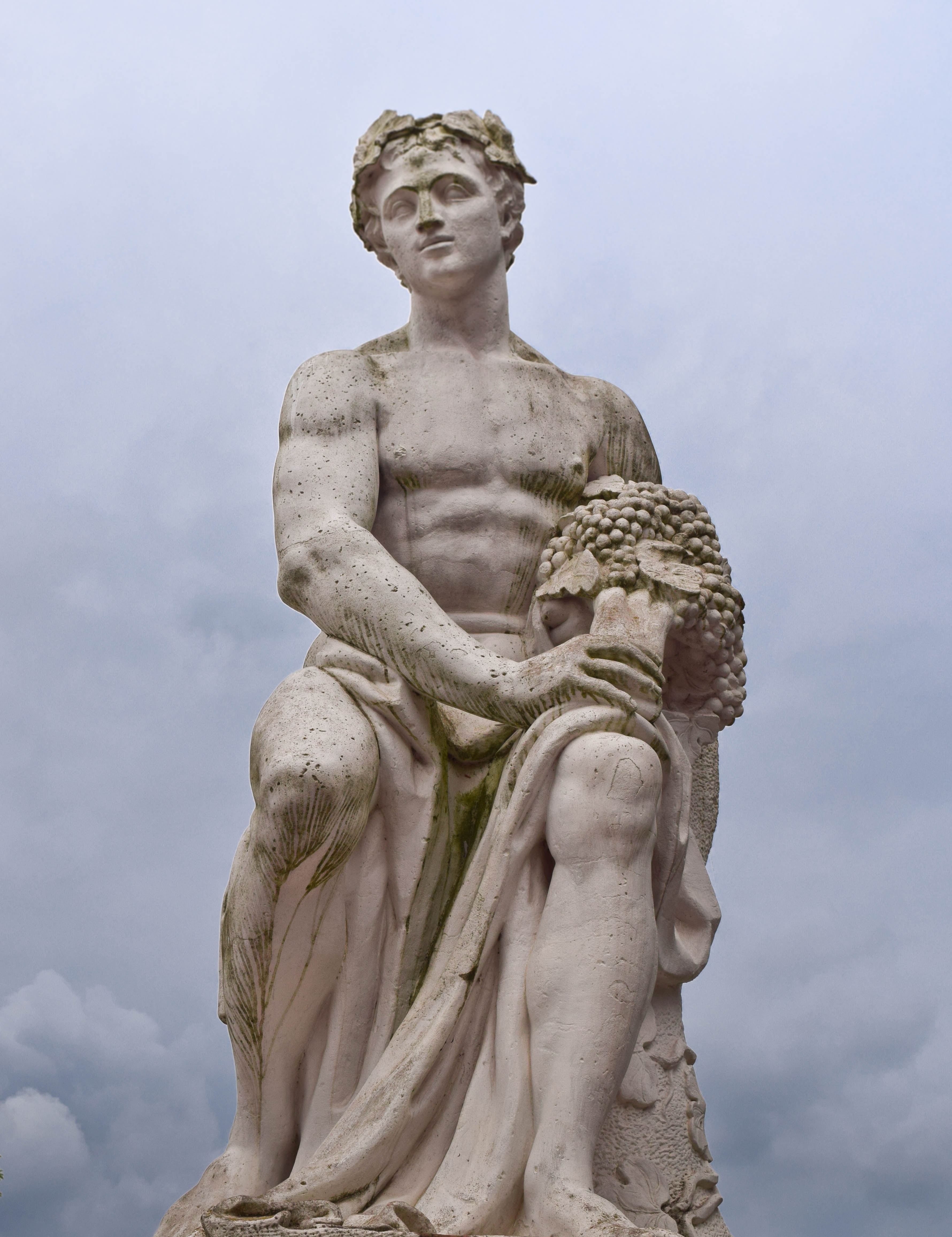
The cult of Dionysus was among the most important of the Greek mystery religions. His myth may have originated in Asia Minor or Thrace, but it certainly had a long pedigree within Greece.[xi]
Born of a Virgin: Unlike the Christian God, Zeus was very keen on having sex with mortal women. He fathered Dionysus by seducing a beautiful young woman called Semele.[xii]
Born on December 25th: There is no evidence for this claim. The main Dionysian festivals took place between late January and early April, though there was one smaller, localised festival in late December/early January.
Travelling Teacher: True, but his message was very different from Jesus. Dionysus was mostly concerned with teaching people how to make wine and have wild parties.
Turned Water into Wine: True. That’s what Dionysus was all about.
Called “Holy Child”: Spencer McDaniel lists a number of epithets given to Dionysus: “Pussy Fucker”, “He of the Testicles” and “Loud Roaring One”. There is no evidence that he was ever called “Holy Child”. That wasn’t his image at all.
SOME CONCLUDING THOUGHTS
This meme and others like it are pseudo-historical claptrap. As an atheist, my heart sinks every time I see them. The ideas they contain come from sensationalist books written by know-nothing authors who knowledgeable mythicists such as Richard Carrier and Robert M Price consider an embarrassment.[xiii]
Hugh Bowden, in his book Mystery Cults in the Ancient World, says: “The evidence we have been examining suggests that there was little contact between Christianity and mystery cults at any time.”[xiv]
We know how the myth of the virgin birth originated, and it was nothing to do with any pagan influence. It was due to a mistranslation of Isaiah 7:14 and its misappropriation by the early church.[xv]
We have a good idea why Christians came to believe that Jesus was born on December 25th, and again it has nothing to do with pagan influences. The early church believed that Jesus must have died on the same date as his conception, and they fixed this as March 25th. From here, all you have to do is add nine months and you get December 25th.[xvi]
The star in the east has a biblical, not a pagan origin. The early church mined Jewish scripture for passages that could be interpreted as prophecies about Jesus. Among those they latched onto was Numbers 24:17: “A star shall come out of Jacob.”
Academic historians are pretty much unanimous in the view that the crucifixion of Jesus was an historical event, and it isn’t difficult to propose a reasonable, non-supernatural, non-pagan explanation of why his followers came to believe in his resurrection.[xvii]
It is to be hoped that my fellow atheists who wish to criticise Christianity will eventually tire of the kind of nonsense contained in this meme and learn to listen to what real historians and historical-critical scholars of the Bible (some of them atheists and agnostics, some of them intellectually honest Christians and Jews) have to say. But in this era of internet echo chambers and social media algorithms that prioritise engagement over veracity, this is perhaps a forlorn hope.

If you have enjoyed this blog post, you may enjoy my novel The Omega Course, which uses fiction to explore the origins of Christianity and the Bible. Click here for details.
[1] My account of Horus is largely taken from Spencer McDaniel’s excellent blog Tales of Times Forgotten https://talesoftimesforgotten.com/2019/11/24/was-jesus-copied-off-the-egyptian-god-horus/ (accessed 28/06/2026).
[2] See Bowden, Hugh; Mystery Cults in the Ancient World, Thames and Hudson, 2010, pp. 179-197.
[3] Ferguson, John; The Religions of the Roman Empire, Thames and Hudson, 1970, pp. 47-49.
[iv] Bowden, Hugh; Mystery Cults in the Ancient World, pp. 198, 209-211.
[v] Bowden, op cit, p. 202. In another version of the myth, he was born from an egg.
[vi] Contrast Ferguson, John; The Religions of the Roman Empire, p. 239 with Bowden, Hugh; Mystery Cults of the Ancient World, pp. 202-205.
[vii] Zaehner, RC; Hinduism, Oxford University Press, 1962, p. 91. See also https://www.britannica.com/question/What-is-the-story-of-Krishnas-birth (accessed 29/06/2026).
[viii] https://www.britannica.com/question/What-is-Janmashtami-and-why-is-it-celebrated (accessed 29/06/2026).
[ix] Zaehner, RC; Hinduism, pp. 92-100.
[x] Geza Vermes, in his magisterial The Authentic Gospel of Jesus (Penguin Books 2004), barely mentions John at all.
[xi] Most of this section is taken from Tales of Times Forgotten: https://talesoftimesforgotten.com/2019/12/03/was-jesus-copied-off-the-greek-god-dionysos/ (accessed 29/06/2026).
[xii] Bowden, Hugh; Mystery Cults in the Ancient World, pp. 25-26. There is another, much later, version of the myth in which Zeus fathered Dionysus by seducing his niece Persephone. When she was dismembered by Titans, Zeus used Semele as a surrogate mother.
[xiii] See Ehrman, Bart; Did Jesus Exist: The Historical Argument for Jesus of Nazareth, HarperOne, 2012, pp. 25-30. I have written about Carrier and Price elsewhere: see https://paulclark42.com/2023/06/17/review-of-jesus-from-outer-space-by-richard-carrier/ and https://paulclark42.com/2026/01/18/review-of-the-christ-myth-theory-robert-m-price/.
[xiv] Page 234.
[xv] Hayes, Christine, Introduction to the Bible (Kindle Edition), Yale University Press 2012, Loc 4660. I have discussed it in a previous blog post: https://paulclark42.com/2024/04/15/how-reliable-is-the-nativity-story/ (accessed 29/06/2026).
[xvi] See https://historyforatheists.com/2024/12/pagan-christmas-again/ (accessed 29/06/2026).
[xvii] I have summarised the argument in three blog posts. See https://paulclark42.com/did-the-resurrection-really-happen/ (accessed 29/06/2026).

