By Paul Clark
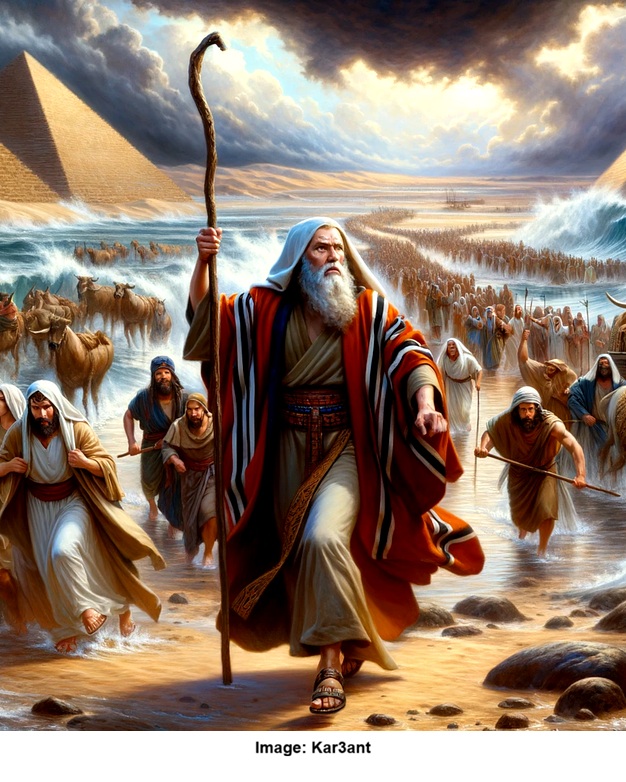
The story of the Exodus from Egypt is central to Jewish identity. It is a story of liberation from slavery that has inspired not only Jews but also abolitionists, the American civil rights movement and the anti-apartheid movement in South Africa.
But is this story based on real historical events? Was there really a man named Moses who led his people from slavery to the borders of the promised land? Can we trust the Bible’s narrative?
THE STORY
The Book of Genesis tells the story of Jacob and his sons, including Joseph, and how the Israelites settled in Israel to escape famine in Canaan.[i] But eventually, the Egyptians enslaved their descendants, who were only freed after a series of plagues affected the Egyptians.[ii]
The Bible says 600,000 Israelite men and their families departed.[iii] Because of their lack of faith, God detained them in the wilderness for 40 years, much of it spent at Kadesh Barnea.[iv] Eventually, under Joshua, the Israelites invaded the promised land, driving out or slaughtering many of its original inhabitants.
ARCHAEOLOGISTS
When archaeologists descended on the region in the 19th and early 20th centuries, they had some success in backing this story up.[v] They managed to locate many of the places in the Biblical account, such as Kadesh Barnea and the city of Pi-Ramesses, which the Bible says was built by Israelite slaves.[vi] Once they learnt to read hieroglyphics, historians were able to build up a very detailed, year-by-year account of Egyptian history.[vii]
THE HYKSOS
Among other things, Egyptian sources told the intriguing story of the Hyksos, a Semitic people whose story seemed to mirror the Israelite Exodus. The Hyksos settled in Egypt in large numbers, much like Jacob and his sons. They established themselves as rulers of northern Egypt (a bit like Joseph?), but eventually the Egyptians rose up and drove them out.[viii]
Is this the Exodus story from the Egyptian point of view? On the face of it, it looks very similar. But when you try to date the Exodus, you run into trouble. The Bible’s chronology puts the Exodus sometime between 1491 and 1440 BCE.[ix] Unfortunately, this doesn’t chime with the Hyksos, who left Egypt a hundred years earlier.
Nor does it chime with the city of Pi-Ramesses, built by Ramesses the Great, who became Pharoah in 1279 BCE.[x] So, if the Bible is correct about Israelite slaves building Pi-Ramesses, then the Exodus took place at least two hundred years after dates given by the Bible, and three hundred years after the Hyksos.
EGYPT AND THE HEBREWS
Historians have found a brief record of a military campaign the Egyptians waged against the Hebrews in the year 1207 BCE. This is the first ever historical record of the Israelites, and it places them inside the promised land.[xi]
So, if the Bible is correct and the Israelites built Pi-Ramesses, the Exodus can only have happened between 1279 and 1207 BCE.[xii] This doesn’t fit the dates given by the Bible. In any case, at that time, Egypt controlled both Sinai and Canaan. So even if Moses and the Israelites had made it across the Red Sea, they would have run into powerful Egyptian armies on the other side.[xiii]
A MASSIVE EXODUS
Also, Egyptologists can find no evidence whatsoever for the departure of 600,000 Israelite men and their families from Egypt – more than a quarter of the total population. But that is what the Bible claims. [xiv]
What’s more, archaeologists have scoured the Sinai without finding a single trace of the wanderings of the Israelites. At Kadesh-Barnea, for example, where they are supposed to have stayed for decades, there is no archaeological evidence of them whatsoever.[xv]
So, what do we go with? The details in the Bible and the Bible’s dates? Or the archaeological evidence? We have to choose one or the other. They can’t both be right.
THE CONQUEST OF CANAAN
The story of the conquest of Canaan is told in the Book of Joshua, and it is one of the most horrific parts of the Old Testament. It is at best a tale of ethnic cleansing, and at worst genocide. If Joshua were alive today, he would deserve to end his days in the hands of the International War Crimes Court at The Hague.[xvi]
But the Biblical story doesn’t chime with the findings of historians and archaeologists.
The first generations of archaeologists thought it did. They discovered evidence of fire and the destruction of city walls at Jericho and assumed they had found traces of the Biblical story of the fall of that city. [xvii] No such luck. We now know that there were no walls around Jericho or any other Canaanite city in the 1200s BCE. The Egyptians dominated the region and wouldn’t have allowed it.[xviii]
So, what is the real story? Who were the Israelites and where were they from?
There is no archaeological evidence of any mass invasion of Canaan in the 1200s BCE. But somebody did invade in the following century, and it wasn’t the Israelites. These invaders were the “Sea Peoples” from the north, possibly from Greece. Among them were some of ancient Israel’s greatest enemies: the Philistines.[xix]
THE BRONZE-AGE COLLAPSE
The 1100s BCE was a time of massive disruption in the eastern Mediterranean. Archaeologists call it the Bronze Age Collapse. Before this time, two powerful empires flourished, the Hittites in the north and the Egyptians in the south. To the north-west, Mycenaean Greece prospered too, and there were extensive trade links between these three civilisations.
Then everything fell apart and nobody really knows why. Populations fell, cities were destroyed, cultivation ceased and trade routes were disrupted. Mycenaean Greece and the Hittite Empire disintegrated, and Egypt seems to have survived by the skin of its teeth.
And in the western highlands of Canaan, a new settled community seems to have emerged: the Ancient Israelites.
PASTORALISTS AND FARMERS
To understand what happened, you need to know something about the relationship between settled farming communities and pastoralists who move around with their sheep and goats. Farming communities and pastoralists have a mutually beneficial relationship. Pastoralists get grain from settled farmers, and farmers get milk, cheese and meat from pastoralists.[xx]
So, a pattern emerges. In the most fertile land, you have settled farming, and in the more marginal lands, you have pastoralists and their flocks.
But what happens if you have war and the destruction of the farming communities in the most fertile areas? If that happens, the pastoralist way of life in the marginal areas becomes unsustainable because there is no grain for them to eat. So, some of the pastoralists settle down and become farmers.
If the more fertile lands become productive again, then this can lead to the abandonment of the settlements in the marginal areas as it becomes more profitable to revert to pastoralism. Archaeologists know that this happened several times in the western highlands of Canaan.[xxi] In their book The Bible Unearthed, Israel Finkelstein and Neil Asher Silberman say the third wave of settlement after 1150 BCE was the largest and most permanent.
THE ISRAELITES
And archaeologists have discovered one crucial difference: in these new settled communities, there is no evidence of the presence of pigs. A taboo against the eating of pork had taken hold, something we associate with the Ancient Israelites, who seem to have arrived as a distinct settled community.[xxii]
They haven’t invaded Canaan or arrived as a wave of immigrants. Invasions and mass migrations leave tell-tale signs in the archaeological record: different ways of making pottery, houses built differently, weapons and tools made to a different design, that sort of thing. There is none of that here.[xxiii] The Israelites are themselves Canaanites, and they have emerged from within Canaanite society. I have already mentioned a brief record of them, presumably as pastoralists, when they were attacked by the Egyptians in the year 1207. But now the Israelites have settled, and they can begin the long process of creating a civilisation complex enough to produce written documentation and eventually put its myths and its history in writing.
NATIONAL MYTHS
These myths would include tales of a miraculous escape from bondage in Egypt. Almost all historians think there is probably a kernel of truth in the story of the Exodus. Some of the ancestors of some of the Israelites may have settled in Egypt for a time and then either left or been driven out.[xxiv] Perhaps there is a connection with the Hyksos. Perhaps not.
It is possible that the slavery aspect of the story reflects later struggles of the Israelites to free themselves from Egyptian domination rather than the status of any ancestors who once lived in Egypt.[xxv] We don’t know. Equally, we have no way of knowing whether there really were leaders called Moses and Aaron. The truth is lost in the mists of time.
Whatever the case, we shouldn’t take the Biblical account of the Exodus any more literally than the tales of King Arthur and the Knights of the Round Table. The Exodus is a national myth of the Israelites and the Jews, just as King Arthur has become a national myth of the English and the Welsh. We are talking about myth here, not history.
Myths can be very powerful. The story of the exodus has played an enormous part in shaping Judaism and the modern state of Israel, just as it has inspired other peoples in their struggles against slavery and oppression. But we should recognise that it is myth, not history.

This blog post is based on an extract from my novel The Omega Course, which uses fiction to explore the origins of Christianity and the Bible. Click here for details.
[i] Genesis 37-50.
[ii] Exodus 7:14-12:30.
[iii] Exodus 12:37.
[iv] Numbers 14:1-12, 33-34.
[v] Finkelstein, Israel and Silberman, Neil Asher: The Bible Unearthed: Archaeology’s New Vision of Ancient Israel and the Origin of Its Sacred Texts. Touchstone, New York 2002, pp. 37-8.
[vi] Finkelstein & Silberman: op cit, p. 56-57, 59, 63.
[vii] Finkelstein & Silberman: op cit, pp. 16-8.
[viii] Finkelstein & Silberman: op cit, pp. 52-7.
[ix] Finkelstein & Silberman: op cit, p. 35, Romer, John: Testament: The Bible and History, Michael O’Mara Books, London 1988, p. 57.
[x] Romer, J: op cit, p. 57.
[xi] Finkelstein & Silberman, The Bible Unearthed, p. 18, Lane Fox, Robin: The Unauthorised Version: Truth and Fiction in the Bible, Viking, London 1991, pp. 225-6, Romer, J: Testament, 1988 p. 73.
[xii] Romer, J: op cit, p. 57.
[xiii] Finkelstein & Silberman: The Bible Unearthed, pp. 76-79.
[xiv] Romer, J: Testament, p. 57.
[xv] Romer, J: op cit, p. 58; Finkelstein & Silberman: The Bible Unearthed, p. 61-64.
[xvi] Dawkins, Richard: The God Delusion, Bantam Press, London 2006, p. 247; Lane Fox: The Unauthorised Version, pp. 224-5.
[xvii] Lane Fox, Robin: op cit, pp. 225-232; Finkelstein & Silberman: The Bible Unearthed, pp. 81-2.
[xviii] Finkelstein & Silberman: The Bible Unearthed, p. 81.
[xix] Finkelstein & Silberman: op cit, pp. 87-9.
[xx] Finkelstein & Silberman: op cit, p. 117.
[xxi] Finkelstein & Silberman: op cit, pp. 113-8.
[xxii] Finkelstein & Silberman: op cit, pp. 118-120.
[xxiii] Barton, John: A History of the Bible: The Book and Its Faiths, Penguin Random House, London 2020, p. 27.
[xxiv] Finkelstein & Silberman:op cit, pp. 68-71; Lane Fox: The Unauthorised Version, p. 176;.
[xxv] Finkelstein & Silberman: The Bible Unearthed, pp. 69-70.
 Paul Clark