By Paul Clark
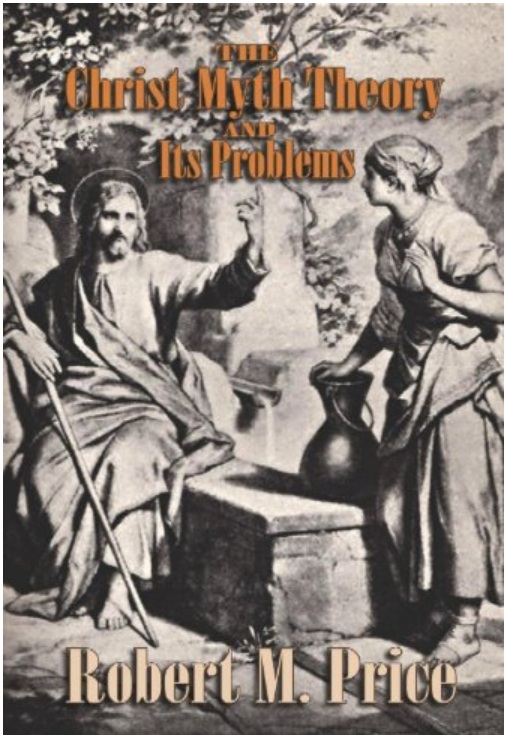
Robert Price is perhaps the only trained and accredited New Testament scholar working today who argues the mythicist case that Jesus of Nazareth never existed. He is a former Baptist minister with a PhD in systematic theology and a formidable knowledge of the relevant literature.
The Christ Myth Theory and Its Problems isn’t a book as such but a collection of articles published elsewhere, which makes it disjointed and repetitive at times. It isn’t really aimed at the general reader but at those who already have a considerable knowledge of the topic.
Unlike Richard Carrier,[i] who is probably the most prominent Jesus mythicist, Price doesn’t present a single over-arching theory. Rather, he offers a collection of sceptical arguments that sometimes fit uneasily together.
In this blog post, I will outline Price’s thesis and arguments before examining why mainstream scholars reject them.
PRICE’S THESIS
Price says Christianity’s origins don’t lie with a preacher called Jesus who was crucified on the orders of Pontius Pilate. Rather, Jesus was a Jewish dying-and-rising god, possibly a hangover from the polytheistic religion of the Ancient Israelites.
It is common for ancient myths to be reinterpreted as legends in which gods are reduced to epic heroes. This is exactly what happened to Jesus, who was “humanised” in the second century CE with the writing of the gospels.
THE EVIDENCE
Price offers five different proofs:
- The “authentic” letters of Paul never refer to Jesus as a human being.
- The dying-and-rising god was a common motif in Greco-Roman and middle-eastern religion.
- Jesus conforms so closely to the mythic hero archetype that he is more likely to be mythical than historical.
- The gospel narratives are cobbled together from the Old Testament and Greek and Middle-Eastern myths.
- The criterion of dissimilarity proves that hardly anything in the gospels can be regarded as historical.
1) THE AUTHENTIC LETTERS OF PAUL
With the exception of Price, just about every New Testament scholar agrees that seven of the 13 Pauline epistles in the Bible are authentic and were penned by Paul some time between 50 and 62 CE.[ii]
Paul certainly says very little about Jesus the human being, but there are four passages that touch on him.
- 1 Thessalonians 2:14-15 – Jesus was killed by the Jews
- Galatians 1:19 – Jesus had a brother called James, who Paul met
- Galatians 4:4-5 – Jesus was a Jew, born of a woman
- Romans 1:3 – Jesus was descended from David
Price claims these seven letters were written in the second century CE.[iii] The versions we have today are not authentic but have been heavily redacted to expunge heretical arguments and to insert passages about Jesus the human being (points 1, 3 and 4 above: price accepts the authenticity of the second point about James but not its standard interpretation).
There are a number of problems with Price’s thesis.
THE IMPORTANCE OF PAUL
Firstly, for both mainstream scholars and for mythicists such as Carrier, Paul’s letters matter because they are our earliest Christian documents and (since Paul met Peter and James) the closest connection we have to them.[iv] For mainstream scholars, their importance is enhanced by the dates ascribed to them: the first was written just 20 years after Jesus died, and Paul met Peter and James as little as three years after the crucifixion.
By placing them in the second century and denying Pauline authorship, Price severely diminishes their importance. Why hang a radical theory on such late documents?
MARCIONITES
Price claims that at least some of the Pauline epistles were written by Marcionites, a Christian group that rejected the Old Testament. But he also claims that Marcionites wrote Mark’s gospel (which Marcion himself disdained) and an early version of Luke. Why would the same group write “mythicist” Pauline epistles and humanising gospels? And why would they draw on an Old Testament they despised to write these gospels, as he says in his fourth proof?
THE IMPORTANCE OF DATES
Mainstream scholars would argue that we have good reason to reject Price’s dating of the authentic Pauline epistles. They are clearly rooted in time and place. Though they contain theological arguments, the purpose of them was not theological. Neither was it to preach the gospel. It was to exercise authority over churches Paul had founded in the Greek-speaking world.[v] In particular, he wanted to put an end to misbehaviour by and internal disputes between members of those churches, and to counteract the influence of outsiders, among them supporters of Peter and James.
To my mind, it is quite easy to understand why Paul would want to say little about the earthly Jesus. Peter’s authority came from having been Jesus’ closest disciple and James’s authority from being his brother. But Paul never met the living Jesus; all his authority came from his encounters with the risen Christ, and so it is the risen Christ that he emphasises.
2) DYING AND RISING GODS
These are absolutely central to Price’s argument. In the late 19th century James George Frazer’s book The Golden Bough popularised the idea that dying-and-rising gods were an important part of Greco-Roman and Middle-Eastern religion. Such myths were initially connected to agriculture and the changing of the seasons but later, in the mystery cults, they took on a more spiritual aspect.
Price cites Attis, Adonis, Tammuz/Dumuzi, Dionysus, Osiris, Baal, Marduk, Mithras and possibly Joshua and Yahweh as dying-and-rising gods.
A SIGNIFICANT CATEGORY?
Today, most scholars are sceptical about the dying-and-rising god as a significant category.[vi] Attis was a god that died. He never returned to life but his corpse remained intact. Adonis was a god-like mortal who died. His cult was a variation of the cult of Tammuz/Dumuzi, a god that died and never returned.
Osiris was murdered and dismembered. When his wife Isis reassembled him, he came back to life, but not among the living. He became lord of the underworld, god of the dead. Marduk never died but was a disappearing-and-returning god, like Demeter’s daughter Persephone.
Dionysus is indeed a dying-and-rising god in some late versions of his myth. Baal is killed and swallowed by Mot, the god of death. But when Baal’s sister-consort kills Mot and scatters his ashes, Baal returns. However, Mot later comes back to confront Baal again. Victory over death can never be permanent. The seasons come and go.
Price’s suggestions that Joshua was originally a god and that Yahweh was a dying-and-rising god are pure speculation; the evidence he presents is tenuous at best. And regarding Mithras, we actually have no information whatsoever about any legends associated with the Roman version.[vii]
NOT AN AGRARIAN MYTH
Another point to note is that, unlike the myths of dying-and-rising/disappearing and returning gods, the myth of Jesus’ death and resurrection has nothing to do with the passing of seasons or the agricultural cycle. Instead, it is seen as a cosmic event that marks the redemption of mankind.
A WEAK ARGUMENT
For all the reasons given above, I would suggest that the claim that Christianity emerged as a Jewish take on the cult of dying-and-rising gods has little evidence to back it up.
3) THE MYTHICAL HERO ARCHETYPE
This was developed in the 20th century by psychoanalyst Otto rank and anthropologist Lord Raglan. Raglan’s version posits 22 characteristics of the archetypal hero, and the idea is that the more of these characteristics any figure conforms to, the more likely they are to be mythical.
With some stretching of the boundaries, Price suggests that Jesus conforms to 19 out of 22 characteristics – a very mythical score. Unfortunately, Abraham Lincoln scores a maximum 22. John F. Kennedy, Winston Churchill, Napoleon and William Wallace score highly too, and Tsar Nicholas II scores higher than Harry Potter.[viii]
This would suggest that the archetype isn’t a very reliable way of telling myth from history.
4) THE GOSPEL NARRATIVES ARE COBBLED TOGETHER FROM OLD TESTAMENT AND OTHER MYTHS
Price equates this with midrash, a Jewish method of analysing scripture that is believed to have originated around the first century CE. In midrash-influenced Judaism, the Hebrew Bible isn’t seen as a single narrative in the way that Christians see it. Rather, it is a collection of sayings, and their context is unimportant.[ix] If there is any sense in which one passage can be connected to another, no matter how distant, then it is legitimate to analyse them together.
However, Jewish scholars didn’t use midrash to weave an enormous number of passages together to form a lengthy and coherent narrative,[x] which is what Price claims happened with the gospels.
SATURATED
It is certainly true that the gospels are saturated with stories drawn from the Old Testament (Matthew’s nativity is a prime example). But in many cases where there are parallels, as a scientist might say, it is easy to show a correlation but extremely difficult to prove cause and effect.
Price’s book has a lengthy chapter in which he details how just about every incident in the gospels is drawn from the Old Testament or other myths. I have to confess that, as a lay reader, wading through this chapter felt like reading long lists of begats in Genesis. I was relieved when I got to the end!
In some cases, Price is clearly correct. In others, he is pointing out parallels but failing to prove a connection. And some of his claims are plainly ridiculous.[xi] My favourite is his suggestion that Joseph of Arimathea asking Pilate to release Jesus’ body is copied from King Priam begging Achilles to return the body of Hector. So, we have two stories where someone asks for a body. Of course one must have copied the other!
THE MARCION CONNECTION
Add to this the fact (see above) that Price claims that Mark and the original version of Luke were written by Marcionites, people who utterly rejected what we now call the Old Testament. Why on earth would they mine a book they detested for their narrative?
5) THE CRITERION OF DISSIMILARITY
The book begins with a chapter on the criterion of dissimilarity, a technique developed in the 1950s to try to asses the reliability of passages in the Gospels. If Jesus is reported to have said or done something that conflicted with the doctrines of the early church and conflicted with standard Jewish teaching, this would add weight to the view that it is authentic.[xii]
An example is Mark 13:32, where Jesus is talking about when the Kingdom of Heaven will arrive: “But about that day or hour no one knows, not even the angels in heaven, nor the Son, but only the Father.”
But church doctrine soon painted Jesus as God incarnate, in which case he would know about the hour and the day. For this reason, when Matthew repeats the passage, he leaves out “nor the son”, and Luke omits the passage altogether. So here, the criterion of dissimilarity suggests that perhaps Jesus did say he didn’t know when the day would come.
Scholars use this criterion sparingly and cautiously. They probably apply it to less than a dozen gospel traditions.
What Price has done is to turbo-charge the criterion of dissimilarity and turn it on its head: if Jesus does or says something that matches either standard Jewish teaching or early church doctrine, it must be inauthentic. This proves that nothing in the gospels is authentic.
What?
This has to be nonsense. Jesus was a man of his time. Of course, most of what he said would conform to standard Jewish teaching. The early church wanted to preserve the memory of Jesus. Of course, a lot of their doctrines would be based on things he said and did.
TROLLING
I worried about this chapter for a long time. How could Price be serious? It was almost as if he was trolling New Testament scholars.
And then it occurred to me that perhaps this is exactly what Price was doing. Maybe he enjoys being an omni-sceptic. He seems to like taking the most extreme position available, even if that contradicts another extreme position he has taken on a different issue.
Despite his encyclopaedic knowledge of the source materials, I don’t see Robert Price as a serious historian. He is a provocateur, a polemicist, a historical-critical scholar gone feral. Maybe there is nothing wrong with that. Intellectual iconoclasts have their place in an open society. They keep more serious scholars on their toes and they can even be fun.
But it is a mistake for lay readers who want to learn about the origins of Christianity to take Price seriously. They should read Bart Ehrman, Paula Fredriksen or Geza Vermes instead.
___

If you have enjoyed this blog post, you may enjoy my novel The Omega Course, which uses fiction to explore the origins of Christianity and the Bible. Click here for details.
[i] Price and Carrier’s mythicist arguments overlap, but there are big differences between them and they cannot both be right. For an analysis of Carrier’s arguments, see my review of his book Jesus From Outer Space https://paulclark42.com/2023/06/17/review-of-jesus-from-outer-space-by-richard-carrier/
[ii] Most mythicists, including Carrier, concur.
[iii] In the mythicism debate between Price and Bart Ehrman, Ehrman is genuinely shocked when Price says Galatians wasn’t written by Paul: see https://www.youtube.com/watch?v=GzjYmpwbHEA&t=1761s (accessed 17/01/2026).
[iv] Most non-conservative scholars believe the letters that bear Peter and James’ names were not written by them and that we have no reason to believe any of the authors of the gospels knew Peter.
[v] Romans and Philemon are different. In Romans, Paul was introducing himself and seeking support for a mission to Spain. His letter to Philemon concerns a runaway slave.
[vi] See Ehrman, Bart: Did Jesus Exist? The Historical Argument for Jesus of Nazareth, HarperOne, 2012, pp. 226-230.
[vii] Bowden, Hugh: Mystery Cults of the Ancient World, Thames and Hudson, 2023, p.198.
[viii] See https://everything.explained.today/Rank%E2%80%93Raglan_mythotype/ (accessed 18/01/2026).
[ix] Barton, John: A History of the Bible: The Book and Its Faiths, Penguin Books, 2020, p. 322.
[x] McGrath, James F: Review of The Historical Jesus: Five Views. Jesus at the Vanishing Point by Robert M. Price, https://www.patheos.com/blogs/religionprof/2010/06/review-of-the-historical-jesus-five-views-jesus-at-the-vanishing-point-by-robert-m-price.html (accessed 18/01/2026).
[xi] See Ehrman, Bart: Did Jesus Exist? pp. 198-204.
[xii] See Martin, Dale B: New Testament History and Literature (Yale University Open Course Series) Kindle Edition, Yale University Press, 2012, pp. 185-7.
 Paul Clark
One response to “Review of The Christ Myth Theory & Its Problems by Robert M Price”
[…] Paul Clark has a view of Robert Price’s The Christ Myth Theory and Its Problems. From the final lines: “But it is a mistake for lay readers who want to learn about the origins of Christianity to take Price seriously. They should read Bart Ehrman, Paula Fredriksen or Geza Vermes instead.” I second that (especially Fredriksen). […]