By Paul Clark
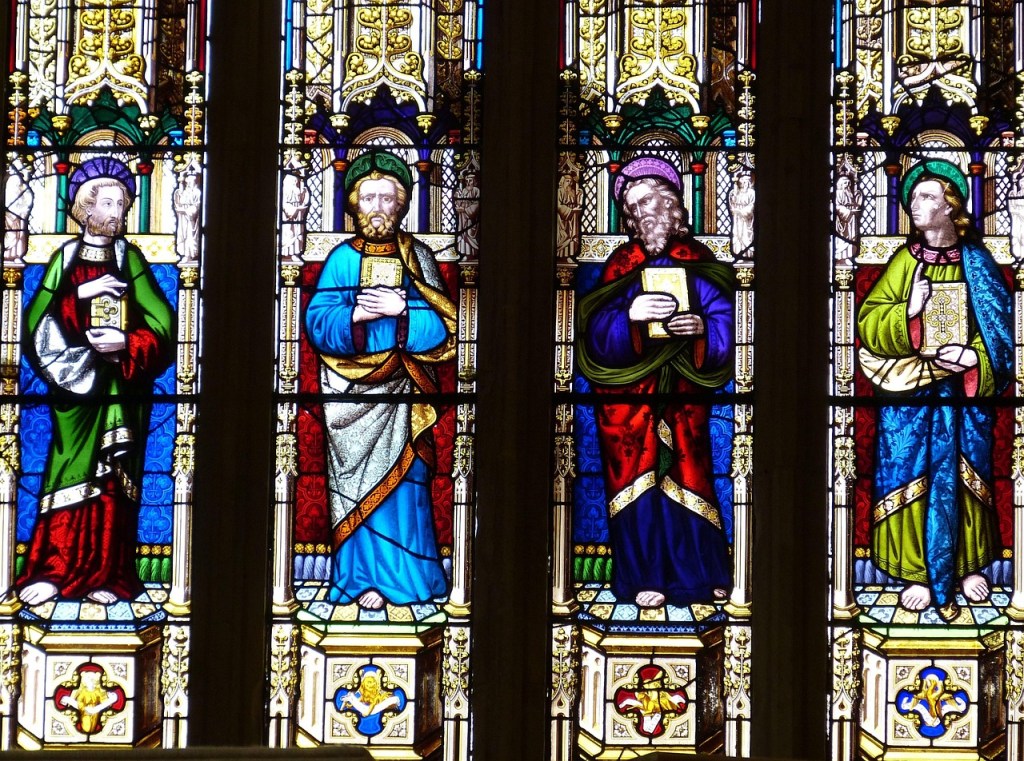
Christian tradition says that Matthew was a tax collector and one of Jesus’ followers; Mark knew both Peter and Paul; Luke was a companion of Paul; and John was Jesus’ favourite disciple.
Modern historical-critical scholars are pretty much unanimous that none of these people wrote any of the gospels.
ATTESTATION
Scholars would cite two kinds of evidence for this view. The first is attestations: when did people begin to write about the gospels, and when did they start to say that Matthew, Mark, Luke and John wrote them? Paul’s letters, probably written between 49 and 62 CE, show no awareness of the gospels’ existence, but by the early second century, Christian writers were beginning to quote from them. However, they weren’t called by their current names until around the year 180.[i]
(According to a 4th-century document, Bishop Papias of Hierapolis mentioned Matthew and Mark early in the 2nd century, but even if Papias was referring to the gospels we have today, which is doubtful, he is generally regarded as a very unreliable source.)[ii]
INTERNAL EVIDENCE
The second kind of evidence that scholars cite is evidence internal to the gospels themselves. The most important point is the fact that all four gospels were originally composed in Greek.[iii] This almost certainly rules out Mark and John, who were probably illiterate speakers of Aramaic. Matthew, as a customs officer, may have had some basic level of literacy, possibly even in Greek, but it is very unlikely that he would have been educated enough to write a sophisticated book.
Mark’s gospel shows a lack of familiarity with local customs and the geography of the region in which its narrative is set, which makes it highly improbable that the author was a Palestinian Jew. Most scholars believe he was a Greek-speaking Jew living in Antioch in northern Syria, or possibly in Rome.[iv]
A 40-YEAR GAP
In the year 66 CE, there was a massive Jewish revolt against Roman rule. Four years later, the Roman army recaptured Jerusalem and destroyed the Temple. It is clear from the text that the author of Mark, the earliest gospel,[v] knew this catastrophic event was either imminent or had already taken place.[vi] This dates the composition of the gospel to around 70 CE.
This means there was a gap of about 40 years between the crucifixion and the writing of the first gospel. Scholars agree that during this period, memories of Jesus were almost entirely preserved and transmitted orally.
MEMORY
In his groundbreaking book Jesus Before the Gospels,[vii] Bart Ehrman draws on psychological and sociological research into memory to ask how accurate early Christian memories of Jesus would have been.
Psychologists have long understood that when we remember an incident, we don’t extract some kind of video recording from a memory file. Rather, bits and pieces of memory are stored in different parts of the brain, and, because these fragments of memory leave gaps that we have to fill in, the act of remembering is a process of creative reconstruction.
Any errors generated in this reconstruction are likely to be recycled when we try to remember the same incident again, which means that memories, which deteriorate rapidly just after an event, continue to deteriorate over time.[viii] The upshot is that eyewitness reports, even of stand-out events, are likely to be flat-out wrong when it comes to detail.[ix]
When a memory is transmitted to another person, who then transmits it to a third person and so on, the remembered event can quickly become unrecognisable.[x]
THE CONTEXT OF MEMORY
Ehrman discusses the context of memory. We don’t remember in the past; we remember in the present, and what we remember is shaped by our beliefs and our social context in the present.[xi]
BETTER MEMORIES
Christian apologists sometimes claim that people in an oral culture in the ancient world had better memories than we do today. Whilst it is true that the Greeks and Romans devised brilliant memory techniques that are still used by memory champions today, research indicates that people living in oral cultures don’t have better memories than us. Indeed, their memories are likely to be worse because they have nothing to check them against.[xii]
REMEMBERING EPIC POEMS AND STORIES
Different researchers have extensively examined the way communities in Yugoslavia, Ghana, Rwanda and Burundi use oral recital and storytelling to preserve their cultures. What they have found is that each recital is unique, shaped to suit its audience and its context. Ehrman writes: “Traditions in oral cultures do not remain the same over time but change rapidly, repeatedly and extensively.”[xiii]
From this, Ehrman concludes that it simply wasn’t possible to preserve an accurate memory of Jesus’ words and actions over a span of decades, particularly because none of the gospel authors were eyewitnesses, and it is possible that none of them had even met an eyewitness. Their source was just as likely to be someone whose “cousin had a neighbor who had once talked with a business associate whose mother had, just fifteen years earlier, spoken with an eyewitness who told her some things about Jesus.”[xiv]
WHY WRITE GOSPELS?
Many scholars say that the gospels fall within the tradition of classical biography. Ancient Greek and Roman biographies weren’t like modern biographies, which aim to tell their subject’s story and get under their skin so as to help the reader understand what made that person tick. There is surprisingly little of that in the gospels.[xv]
Rather, the purpose of classical biographies was moral education, and it was permissible to invent, edit or omit in order accomplish this.[xvi] The gospels can in many ways be read as parables. They use incidents in the life of Jesus to illustrate theological points.[xvii]
MEMORY AIDS
Another suggestion is that the gospels were written as reminders, or memory aids, notes for preachers. They were initially seen as living texts, subject to revision and expansion. The aim wasn’t to supplant the oral tradition but to increase its memory capacity. It was only later that the church would insist on a fixed, authoritative version.[xviii]
THE SYNOPTIC GOSPELS (MATTHEW, MARK AND LUKE)
Scholars agree that Mark is the source of most of the narrative in Matthew and Luke. In some ways, those two gospels are like exaggerated versions of Mark. For example, when Jesus was arrested, one of his followers drew his sword and cut off the ear of one of the temple guards. Mark says that Jesus shouted at him and told him not to resist. In Matthew, Jesus makes a longer speech, and in Luke, he touches the guard’s ear and heals it.[xix]
The three synoptic gospels each put a very different spin on the story they tell. In Mark, Jesus has to keep the fact that he is the Messiah secret so that prophecy can be fulfilled. The desecration of the Temple in 70 CE signifies the beginning of a period of tribulation that will lead to Jesus’ triumphant return.[xx]
A JEWISH GOSPEL
Matthew, despite its invective against those Jews who reject Jesus, is the most Jewish of the gospels. It is structured into five sermons, reflecting the five books of the Pentateuch. Its birth narrative stresses the fulfilment of prophecy and paints Jesus as the new Moses. The author is a Greek-speaking Jewish Christian, possibly from Antioch, writing between 80 and 90 CE. He expects gentile converts to follow Jewish law to the full, including dietary restrictions and male circumcision.[xxi]
LUKE
Luke is perhaps the most thematically complex of the gospels. In many respects, it depicts Jesus as a prototypical Old Testament prophet who fulminates against the rich and expresses concern for the poor, and who is rejected and killed by the religious establishment.[xxii] Luke is also keen to show the Roman authorities that Christianity isn’t a threat to them.[xxiii]
This gospel must be read in conjunction with Acts of the Apostles, which was written by the same author, someone highly educated and proficient in the arts of rhetoric. He was probably a gentile convert but may have been a Hellenised Jew. There is some debate about the date of composition: some scholars place it between 80 and 90, others as late as 110 CE. [xxiv]
THE “WE” PASSAGES
One reason Christian apologists claim that Luke-Acts was written by a companion of Paul is that Acts contains a number of “we” passages, written as if the author was present in the events he is describing.
However, Luke’s portrait of Paul’s mission frequently conflicts with what Paul himself says in his epistles,[xxv] and Paul never mentions a companion called Luke – all references to him are found in epistles that bear Paul’s name but which most scholars agree weren’t written by him.[xxvi] For this reason, most scholars believe the “we” passages were inserted for literary effect.[xxvii]
Another possible insert is Luke’s story of the nativity. Chapter 3 of Luke reads like the beginning of a narrative, and many scholars believe that chapters 1 and 2 were inserted later.[xxviii]
JOHN
John’s gospel is not the work of a single author but has a complex history of composition.[xxix] Chapter 21:24-5, which identifies the author as the favourite disciple of Jesus, is almost certainly a later addition.[xxx] This gospel, which reached its final form some time after 90 CE, is very Greek, steeped in Hellenistic philosophical and mystical speculation.[xxxi] It is also clearly the product of a Christian community, possibly in Ephesus in Asia Minor, which has been expelled from the local synagogue and has turned against the Jews.
They believe themselves to be the elect and saved, unlike their Jewish and pagan neighbours, who number among the damned.[xxxii] It is also possible that they don’t think much of many of their fellow Christians, since John is so completely different from the Synoptic gospels in terms of its narrative, theology and depiction of Jesus.[xxxiii] In Mark, Jesus is keen to keep his messianic identity secret. In John, he speaks of little else.
WHAT DOES ALL THIS MEAN?
This, then, is the picture of the gospels that the historical-critical approach gives us. Four distinct works written decades after the events they describe, and which cannot possibly represent an accurate record of either Jesus’ words or his deeds. Each of the gospels was written to serve the community that sponsored it. Each puts its own spin on events, and it is impossible to harmonise them.
Though I am myself an atheist, I accept that none of this invalidates Christianity. Indeed, much of the intellectual spadework that has given us this picture of the gospels was done by practising Christians. What this understanding of the gospels does invalidate is a fundamentalist picture of Jesus. If we want to learn about him, we cannot do so by taking the gospels literally.
—
Click here for Part 1 of this post, which focuses on the academic toolkit scholars have used to understand who wrote the Bible.
Click here for Part 2, which looks at the authorship of the core books of the Old Testament.
—
I have also written three posts on the historical Jesus. Click on the links below:
Who was Jesus? Part 1: What is a Messiah? Part 2: Our Sources. Part 3: The Historical Jesus.
—

If you have enjoyed this blog post, you may enjoy my novel The Omega Course, which uses fiction to explore the origins of Christianity and the Bible. Click here for details.
[i] Sanders, EP: The Historical Figure of Jesus, Penguin Books, London 1995, p. 64.
[ii] Ehrman, Bart: Jesus Before the Gospels: How the Earliest Christians Remembered, Changed and Invented Their Stories of the Savior (Kindle Edition), HarperOne 2016, p. 116; Martin, Dale B: New Testament History and Literature (Kindle Edition), Yale University Press, 2012, p. 24.
[iii] Vermes, Geza: Christian Beginnings: From Nazareth to Nicea, AD 30-325, Allen Lane, London 2012, p. xi.
[iv] Barton, John: A History of the Bible: The Book and Its Faiths, Penguin Random House, London 2020, pp. 201-2.
[v] Sheehan, Thomas: The First Coming: How the Kingdom of God Became Christianity, Crucible, Wellingborough 1988, pp. 14-16.
[vi] Martin: New Testament History and Literature (Kindle Edition), p. 91; Barton: A History of the Bible, pp. 199-200; Vermes, Geza: Christian Beginnings: From Nazareth to Nicea, AD 30-325, Allen Lane, London 2012, p. xi.
[vii] Ehrman, Bart: Jesus Before the Gospels: How the Earliest Christians Remembered, Changed and Invented Their Stories of the Savior (Kindle Edition), HarperOne 2016.
[viii] Ehrman, op cit, pp. 134-8.
[ix] Ehrman, op cit, pp. 87-130, 142.
[x] Ehrman, op cit, pp. 137.
[xi] Ehrman, op cit, pp. 230-233.
[xii] Ehrman, op cit, p. 182.
[xiii] Ehrman, op cit, p. 182.
[xiv] Ehrman, op cit, p. 2.
[xv] Martin: New Testament History and Literature (Kindle Edition), p. 79.
[xvi] BBC In Our Time, Plutarch’s Parallel Lives: https://www.bbc.co.uk/programmes/m00260s5 (accessed 18/05/2025).
[xvii] Vermes: Christian Beginnings, p. x; Sanders, EP: The Historical Figure of Jesus, p. 58; Martin: New Testament History and Literature (Kindle Edition), p. 79; Attridge, Harold W (ed): The Harper Collins Study Bible, Fully Revised and Updated (Kindle Edition), HarperOne, 2006, pp. 5,469, 5,680.
[xviii] Shoemaker, Stephen J, Creating the Qur’an: A Historical-Critical Study, pp. 212-213. I have taken this from a section where Shoemaker uses the writing of the gospels as a model for how the Qur’an may have been written.
[xix] Contrast Mark 14:43-52 with Matthew 26:47–56 and Luke 22:47–53.
[xx] Martin: New Testament History and Literature (Kindle Edition), pp. 81-88, 91.
[xxi] Attridge (ed): The Harper Collins Study Bible, pp.5,469-70; Barton: A History of the Bible, p. 193; Martin: New Testament History and Literature (Kindle Edition), pp. 93-102;
[xxii] Martin: New Testament History and Literature (Kindle Edition), pp. 134-6.
[xxiii] Attridge (ed): The Harper Collins Study Bible, p. 5,813.
[xxiv] Marina, Marko: Who Wrote the Book of Luke: Seeking Authorship Clues. https://ehrmanblog.org/the-gospel-of-luke-who-wrote-it-when-and-why/ (accessed 19/05/2025). Attridge (ed): The Harper Collins Study Bible, p. 5,813.
[xxv] Marina: Who Wrote the Book of Luke; Attridge (ed): The Harper Collins Study Bible, p. 5,812.
[xxvi] Marina, Marko: Who Wrote the Book of Luke.
[xxvii] Attridge (ed): The Harper Collins Study Bible, p. 5,812.
[xxviii] Barton: A History of the Bible, p. 198.
[xxix] Barton: A History of the Bible, p. 205; Attridge (ed): The Harper Collins Study Bible, p. 6,014.
[xxx] Vermes: Christian Beginnings, p. 117.
[xxxi] Vermes: Christian Beginnings, p. xii.
[xxxii] Martin: New Testament History and Literature (Kindle Edition), pp. 161-165.
[xxxiii] Martin: New Testament History and Literature (Kindle Edition), pp. 152-157.
 Paul Clark
2 responses to “Who Wrote the Bible? Part 3: The Gospels”
[…] Part 3 will examine the New Testament, looking at the authorship of the gospels. […]
[…] here for Part 3, which looks at the New […]