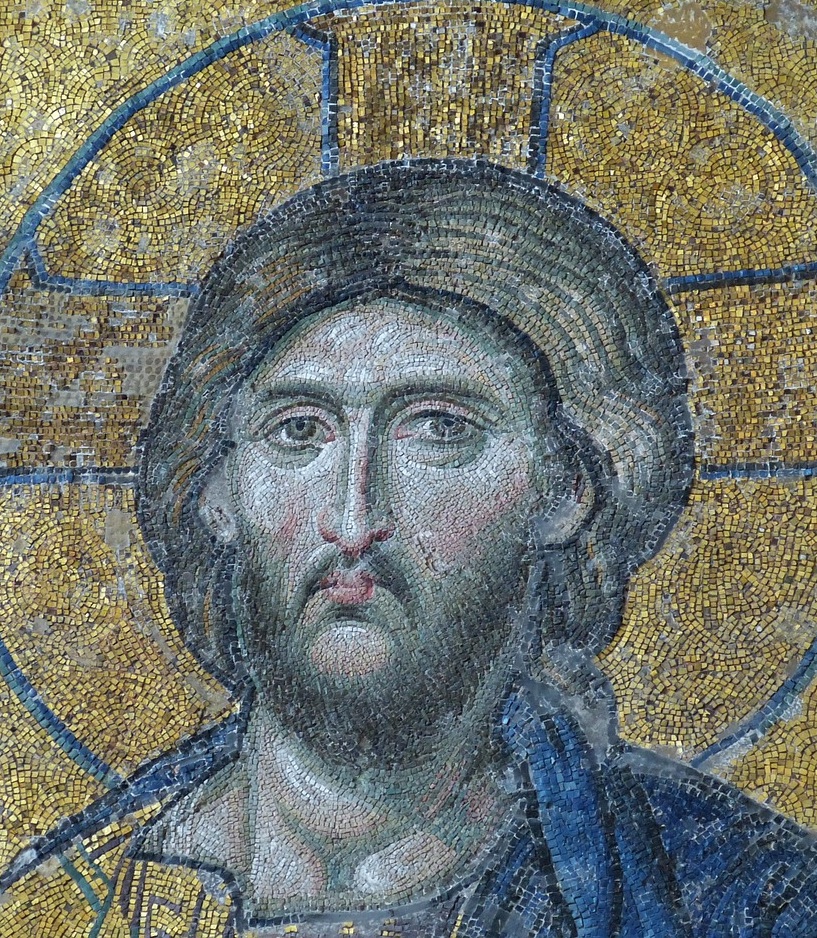
This post will set out what we can know about Jesus, his life and his message. I will indicate where we can speak with some certainty and where the evidence is unclear and different interpretations are possible.
JESUS ALMOST CERTAINLY EXISTED
The first book to suggest that Jesus was a purely mythical figure was written during the French Revolution.[i] “Mythicism” remains popular in some atheist circles but no reputable academic in the field subscribes to this idea today.[ii] Three things (Nazareth, Jesus’ baptism and the crucifixion) are widely accepted as solid evidence that Jesus existed, due to the criterion of embarrassment. All three were an embarrassment for the early church, and it is extremely unlikely that they would have made them up.[iii]
NAZARETH
All four gospels agree that Jesus came from Nazareth. But Matthew and Luke insist he was born in in Bethlehem, and they tell completely incompatible stories to place his birth there.
These nativity stories serve two purposes. The first is fulfilment of prophecy. The early church mined Jewish holy texts for prophecies of Jesus, frequently imposing meanings on the texts that bore no relation to the intentions of their authors. Two classic cases are the virgin birth (Isaiah 7:14) and Bethlehem as the location of Jesus’ birth (Micah 5:2). The former is based on a mistranslation, and the prophecies used in both cases are short-term prophecies about threats to the Kingdom of Judah. They have no connection with anything that happened hundreds of years later.[iv]
The second purpose of these stories was theological. The massacre of the innocents is a parable, the purpose of which is to give pious instruction comparing Jesus to Moses,[v] who was hidden in a reed basket as a baby to escape the massacre of Israelite babies ordered by the Pharoah. In both instances, “A baby is born under extraordinary circumstances; an evil king orders the slaughter of all infant boys of a certain age, but the baby escapes, survives and eventually becomes the one who saves his people.”[vi]
So why did the authors of Matthew and Luke include Nazareth, an unremarkable little village in the back end of beyond?[vii] They had to include it because people knew that was where Jesus was from. We have no reason to believe that Jesus wasn’t born there or that he wasn’t conceived in the normal way.[viii]
JOHN THE BAPTIST
The baptism is an embarrassment because it is inherent in the ceremony that the baptiser (John) is superior to the person being baptised (Jesus). Not a message the early church wanted to give, especially when the followers of John the Baptist were still around as a rival sect.[ix] Also, according to Christians, the purpose of baptism was to wash away sin, but Jesus was supposed to be without sin.[x]
Most scholars believe Jesus was a follower of John the Baptist who broke away to form his own sect. His message was the same as the Baptist’s but its tone seems to have been different, with an emphasis on God’s love and forgiveness. The Baptist may not have approved of Jesus’ mission.[xi]
THE CRUCIFIXION
This was a massive embarrassment because of the shameful and humiliating nature of the punishment, which was reserved for the lowest classes in society. For Jews this was made even worse because Deuteronomy 21:23 says that anyone executed in such a manner is cursed by God.[xii] Why would the early church have made up such a shameful death?
For these three reasons, historians believe it is pretty certain Jesus existed.
WAS JESUS EDUCATED?
In a society where only about 3% of the population could read,[xiii] the son of a rural carpenter or builder wouldn’t normally be able to do so. But in all four gospels, Jesus demonstrates a knowledge of scripture, and in Luke 4:16-20, he is shown reading from Isaiah.
Can these two things be reconciled?
Geza Vermes suggests that possibly they can because Joseph may have doubled as the village rabbi.[xiv] If so, he might have taught his son to read and memorise some holy texts. Even if the gospels exaggerate Jesus’ knowledge of scripture, he may have had a religious apprenticeship. Or he may just have been good at remembering the texts that were read out in his local synagogue.
WHICH NARRATIVE DO WE FOLLOW?
Here we have a problem. In the synoptic gospels (Matthew, Mark and Luke), Jesus’ mission lasted less than a year and mostly took place in rural Galilee. In John, it lasted between two and three years, and Jesus preached extensively in Judea. Luke (2:23) reports that he was about 30 years old when he began, but John (8:57) implies that he was well into his 40s.
Which are we going to believe?
The majority of scholars go with the synoptic gospels, partly because Mark (the source of most of Matthew and Luke’s narrative) was written 20-30 years earlier than John. Also, in the synoptic gospels, Jesus teaches in parables and aphorisms, whilst in John, he delivers long, highly theological speeches. The former is more typical of first-century Judaism;[xv] the latter is more Greek.[xvi]
However, it is possible to make a case for John.[xvii] Even if it was written later than Mark, some of its sources could be earlier, including perhaps people who had known one of Jesus’ disciples. John certainly demonstrates an excellent knowledge of Jewish practice and of Jerusalem before the destruction of the Temple. Even if its theology belongs to a later period (see below), John’s description of the length and geographical reach of Jesus’ mission may not be worthless.
We simply don’t know.
WHAT WAS JESUS’ MESSAGE?
The synoptic gospels present Jesus as a healer, teacher and prophet, with the Kingdom of God at the heart of his message (Matthew calls it the Kingdom of Heaven), while in John is his core message was his divine identity and his role as the pathway to eternal life.[xviii] Most scholars believe that John doesn’t reflect the concerns of the historical Jesus but the christological debates of the late first-century church.
Christology is a theological construct concerning the sense in which Jesus was both human and divine. It can be low (Jesus was a human who became divine) or high (Jesus is divine and became human for a period). The church was riven by fierce christological debates until the Council of Nicea settled on a high christology in 326 CE.
Bart Ehrman suggests that high christologies developed quite rapidly after Jesus’ death, but there is evidence that the first Christians followed a very low christology in which Jesus only became divine after the resurrection. This means that Jesus cannot have taught them that he was God.[xix] For this reason, we can dismiss the theological content of John as inauthentic. The core of Jesus’ message was the Kingdom of God.
WHAT IS THE KINGDOM OF GOD?
The synoptic gospels contain more than one version of the Kingdom of God. All three gospels have multiple passages in which Jesus treats it as an impending eschatological event that will mark God’s final victory over his enemies and the establishment of his divine rule here on earth.[xx]
But Luke (17:21) also says, “The Kingdom of God is within you.” Here, the Kingdom of God is spiritual and ethical, here and now, not a forthcoming eschatological event. (An alternative translation is “The Kingdom of God is in your midst”, suggesting that Jesus himself personifies the Kingdom of God.)
Whilst scholars tend not to dismiss Luke 17:21 as inauthentic, most agree that the primary focus of Jesus’ mission was eschatological. Since Albert Schweitzer pointed it out in 1906, the majority of scholars have accepted that Jesus literally believed the world as we know it was about to end.[xxi] This can be very uncomfortable for the Christians among them, because they have to admit that Jesus was wrong.[xxii]
DID JESUS THINK HE WAS THE MESSIAH?
Scholarly opinion is divided on this question.[xxiii] There is general agreement that Jesus didn’t publicly proclaim himself Messiah, but less agreement about what he believed or what he told his disciples in private. Many scholars, but not all, consider it unlikely that Jesus thought he was the Messiah. If he did think so, it would be as a priestly Messiah rather than a Davidic warrior king.
If we ignore the question of what title to give him, there is a wide consensus that Jesus believed he had a special role to play in the coming of the Kingdom of God. He probably thought he was God’s final emissary. Soon his disciples would sit in judgement over the 12 tribes of Israel and he would sit above them as God’s deputy.
JESUS AS AN ETHICAL TEACHER
Jesus had a radical and novel message of personal redemption in the coming kingdom that was very different from the fire and brimstone of John the Baptist.[xxiv] The beatitudes and the commandment to love your enemies and turn the other cheek are a beautiful invitation to show compassion, humility and love in the face of adversity.[xxv]
But the kind of absolute morality Jesus proposed was predicated on his view that the world was about to end and, provided people could get themselves onside quickly, they too could enter the Kingdom of God.[xxvi] It doesn’t tell us much about how to navigate the real world, where the meek tend not to inherit the earth.
This is not to disparage Christian ethics at their best; it is merely to point out that Jesus himself wasn’t a great moral teacher.[xxvii]
JESUS AS A SOCIAL REFORMER
Jesus also shows disdain for the rich and powerful and compassion for the poor and marginalised. Some have said this shows he was a social reformer. As Albert Schweitzer would have said, they are guilty of searching for the historical Jesus and finding their own reflection or, as another scholar has put it, doing autobiography and calling it biography.[xxviii]
Most scholars agree Jesus’ disdain for the rich was a disdain for their materialism and hypocrisy. They needed to stop clinging onto their wealth if they wanted to be admitted to the Kingdom of God, a kingdom that was also open to the poorest and most marginalised. Jesus wasn’t interested in changing a world that was about to end.
To say this isn’t to deny the role that Christianity has played in movements for social reform, just to note that Jesus himself wasn’t a social reformer.
ONLY THE JEWS
Most scholars agree that Jesus’ message was only for the Jews. He wasn’t interested in preaching to Greeks or Romans, and passages in which Jesus commissioning his disciples to take his message to the wider world aren’t considered authentic. It is possible, however, that he would have expected non-Jews to be converted once the Kingdom of God was established.[xxix]
DID JESUS PREDICT HIS DEATH?
All four gospels contain passages in which Jesus, speaking to the disciples, predicts his own death and tells them it is all part of what must happen. However, Bart Ehrman and Geza Vermes reject these passages as inauthentic. Vermes says the behaviour of the disciples at the time of his arrest and execution show that they were taken completely by surprise.[xxx] He suggests that Jesus fully expected his mission to culminate in the arrival of God’s kingdom on earth, not in his own demise.
However, right at the end it is very possible that Jesus knew he was in big trouble. The synoptic gospels have him praying to God to ask him to “take this cup from me”. Vermes regards both the form and the content of this prayer as authentic.[xxxi]
WHY WAS JESUS EXECUTED?
The credibility of the gospel accounts of Jesus’ arrest and trial is the subject of intense debate among scholars. Was claiming to be the Messiah blasphemous? Did the Jewish authorities have the power to sentence Jesus to death? Did they try him or merely interrogate him? Is the story of Peter sneaking in to see what happened credible? Would Pilate have bothered to interrogate Jesus himself? Did the Romans really free a prisoner called Barabbas?
The answer to most of these questions is that there are all kinds of theories but we don’t really know.[xxxii] All we can say for sure is that Jesus said or did something that frightened or angered the Temple authorities, and they arrested him and, perhaps after interrogating him, handed him over to the Romans, who flogged him and crucified him as a troublemaker.
WHAT HAPPENED NEXT?
Historians are loath to say whether Jesus was resurrected. This, they say, is a theological question, not something historians can assess.[xxxiii] All they can do is note that, very soon after Jesus’ death, some of his followers became convinced that some kind of resurrection had taken place, and this inspired them to continue his work and prepare for his imminent return, which would usher in the Kingdom of God.
I have written about the empty tomb, the resurrection narratives and the reaction of the disciples elsewhere, and invite readers to check out those blog posts.[xxxiv]
THE HISTORICAL JESUS
So this is the picture we have of Jesus – a charismatic Jewish peasant preacher from Galilee who taught that the end of the world was nigh. In Jerusalem, he said or did something that caused the authorities to arrest him and subject him to a horrendous death. He doesn’t seem to have had a massive following, but he had such an impact on his disciples that his sect survived him.
In later decades, his little Jewish sect attracted large numbers of non-Jewish converts and turned into the completely separate religion that we know today. We have no reason to believe that this was what he wanted or expected to happen.[xxxv] This is the paradox of Jesus. On the one hand, the religion he founded has possibly done more to shape the world, for good and ill, than any other set of ideas in history. But in his own terms, he was a complete failure. His aim was to prepare Jews for the imminent end of the world as we know it. But few of them listened, and they were right not to do so because the world didn’t end.
FURTHER READING
An excellent introduction to Jesus the man is The Historical Figure of Jesus by EP Sanders. If you prefer to watch videos, I would recommend Bart Ehrman’s YouTube channel https://www.youtube.com/@bartdehrman .
Click here to go to Part One of this blog post, which looks at the concept of a Messiah.
Click here to go to Part Two of this blog post, which examines our sources for the life of Jesus.
__________

If you have enjoyed this blog post, you may enjoy my novel The Omega Course, which uses fiction to explore the origins of Christianity and the Bible. Click here for details.
NOTES
[i] Ehrman, Bart: Did Jesus Exist? The Historical Argument for Jesus of Nazareth (Kindle Edition), Harper Collins 2012, p. 15.
[ii] Martin, Dale B: New Testament History and Literature (Kindle Edition), Yale University Press, 2012, Loc 3449; Ehrman: Did Jesus Exist? p. 6.
[iii] See Ehrman, Bart D: How Jesus became God: the exaltation of a Jewish preacher from Galilee (Kindle Edition), HarperOne 2014, Loc 1449; See also https://historyforatheists.com/2017/05/did-jesus-exist-the-jesus-myth-theory-again/ (accessed 06/01/2025).
[iv] Barton, John: A History of the Bible: The Book and its Faiths. Penguin Random House, 2019, pp.89-111, especially p.90 and pp. 99-107. Hayes, Christine: Introduction to the Bible, p. 237. Stark, Thom: The Human Faces of God, Loc 1076.
[v] Sanders, The Historical Figure of Jesus, pp.87-88; Martin, Dale B: New Testament History and Literature, Loc 1874; MacCulloch, Diarmaid: A History of Christianity: The first Three Thousand Years (Kindle Edition),Penguin Books 2010, Loc 1865.
[vi] Martin, Dale B: New Testament History and Literature (Kindle Edition), Loc 1873-1880.
[vii] Sanders, EP: The Historical Figure of Jesus, Penguin Books, London 1995, pp. 85-88. Quite how small Nazareth was is unclear. Bart Ehrman suggests a hamlet with just 50 buildings https://ehrmanblog.org/did-nazareth-exist/ (accessed 06/01/2025), whereas Ken Dark suggests a considerably larger population https://www.livescience.com/jesus-home-nazareth-discoveries.html (accessed 06/01/2025).
[viii] Ehrman, Bart: Did Jesus Exist? (Kindle Edition) pp. 294-5. I deal with the nativity in greater detail in https://paulclark42.com/2024/04/15/how-reliable-is-the-nativity-story/
[ix] Acts 19:1-7.
[x] See Acts 19:4 for the Christian view of baptism. Josephus (Antiquities of the Jews 18.5.2) said that for John the Baptist, the ceremony was used to purify the body.
[xi] Sanders, EP: The Historical Figure of Jesus, pp. 93-94
[xii] I discuss Jesus mythicism in greater depth in my review of Richard Carrier’s Jesus From Outer Space https://paulclark42.com/2023/06/17/review-of-jesus-from-outer-space-by-richard-carrier/.
[xiii] Ehrman, Bart: Did Jesus Exist? (Kindle Edition), p. 48
[xiv] Vermes, Geza: Jesus the Jew: A Historian’s Reading of the Gospels. Collins, London 1973. Elsewhere (for reasons other than literacy), Vermes dismisses Luke’s story of Jesus reading from Isaiah as inauthentic: The Authentic Gospel of Jesus, Penguin, London 2004, pp. 30-31.
[xv] Op cit, p. 136.
[xvi] Vermes, Geza: The Authentic Gospel of Jesus, p. xii.
[xvii] Lane Fox, Robin: The Unauthorised Version: Truth and Fiction in the Bible, Viking, London 1991, pp. 202-9. See also https://www.academia.edu/8789383/The_Historical_Jesus_in_the_Fourth_Gospel_A_Paradigm_Shift (accessed 11/01/2025).
[xviii] Rowland, Christopher: Christian Origins, SPCK, London 1985, pp. 126-8.
[xix] Ehrman, How Jesus Became God (Kindle Edition), Loc 3225-3318, 3674-3694; Martin, Dale B: New Testament History and Literature (Kindle Edition), p. 263.
[xx] Matthew 10:7, 10:23, 13:47-50, 16:27-28, 19:28, 22:1-14, 24:3-51, 25:1-13, 25:14-30, 25:31-46, 13:24-43, Mark 1:15, 3:24-27, 9:47-48, 10:29-31, 13:1-37, 8:38–9:1, 4:26-32, Luke 6:20-23, 14:15-24, 17:20-37, 18:7-8, 21:5-36, 12:35-48, 13:22-30, 19:11-27.
[xxi] Ehrman, Bart D: How Jesus became God (Kindle Edition), 1357-1640. Martin, Dale B: New Testament History and Literature (Kindle Edition), p. 192. Sanders, EP: The Historical Figure of Jesus, pp. 175-183. Rowland, Christopher: Christian Origins, pp. 113-116, 133-136.
[xxii] See, for example, Catholic theologian Hans Küng: Küng, Hans: On Being a Christian. Collins, London 1977, pp. 216-8.
[xxiii] For a variety of perspectives, see; Martin, Dale B: New Testament History and Literature (Kindle Edition), p. 194; Ehrman, Bart D: How Jesus became God, Loc 1762-1821; Rowland, Christopher: Christian Origins, pp. 174-187; [xxiii] Sanders, EP: The Historical Figure of Jesus, pp. 238-248.
[xxiv] Sheehan, Thomas: The First Coming: How the Kingdom of God Became Christianity, Crucible, Wellingborough 1988, pp. 57-69
[xxv] Geza Vermes is sceptical about the beatitudes’ authenticity as the words of Jesus, but he accepts that they are an accurate summary of his ideas: Vermes, Geza: The Authentic Gospel of Jesus, p. 316.
[xxvi] Ehrman, Bart D: How Jesus became God, Loc 5248.
[xxvii] I would strongly recommend Tom Holland’s book Dominion: The Making of the Western Mind, Little, Brown 2019, which details the very real benefits Christian ethics have given the world.
[xxviii] Crossan, John Dominic: Jesus: A Revolutionary Biography, Harper Collins 1994, p. xiv.
[xxix] Sanders: The Historical Figure of Jesus, pp. 191-193; Martin: New Testament History and Literature, Loc 1853.
[xxx] Vermes, Geza: The Authentic Gospel of Jesus, pp. 244-251, 385-389.
[xxxi] Op cit, pp. 220-221.
[xxxii] For a summary of the debate, see Rowlands, Christopher: Christian Origins, pp. 164-174.
[xxxiii] Ehrman, Bart D: How Jesus became God, Loc 1960.
[xxxiv] https://paulclark42.com/2024/06/25/empty-tomb/, https://paulclark42.com/2024/07/22/the-resurrection/ and https://paulclark42.com/2024/09/11/disciples/.
[xxxv] ; Martin, Dale B: New Testament History and Literature (Kindle Edition), p. 194.
 Paul Clark
2 responses to “Who Was Jesus? Part Three: The Historical Jesus”
[…] Click here to go to Part Three. […]
[…] Who was Jesus? Part 1: What is a Messiah? Part 2: Our Sources. Part 3: The Historical Jesus. […]