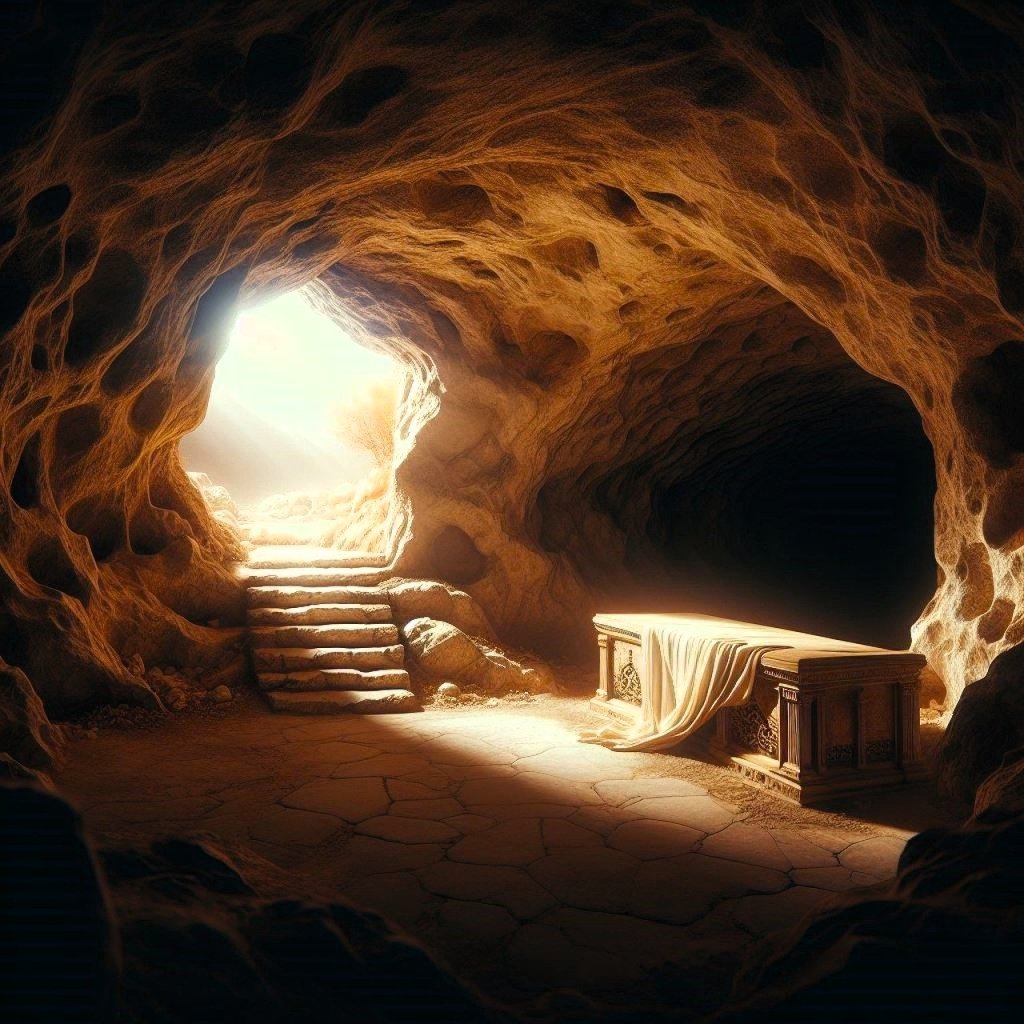
Christians often cite the empty tomb as evidence of Jesus’ resurrection. In this blog post, I will try to answer two questions: Was there an empty tomb? And if so, is it evidence for the resurrection?
TWO DIFFERENT STORIES
The New Testament contains two conflicting stories about Jesus’ burial. The four canonical gospels all say that Joseph of Arimathea interceded with Pontius Pilate to get permission for Jesus to be buried in a tomb.[1]
However, the Book of Acts (written by the same author as Luke’s gospel) seems to record a different tradition. According to this, it was the Jewish authorities who took Jesus down from the cross and buried him in a tomb.[2]
WAS THERE A TOMB AT ALL?
Not everyone is convinced. Bart Ehrman points out that normal Roman practice was for crucified criminals to be left on the cross to rot and be eaten by scavengers.[3] Others have said that this practice was suspended in Palestine out of respect for Jewish traditions,[4] but Ehrman is sceptical about this, quoting contemporary sources that cast doubt on this idea and describe Pilate as a brute.[5]
But even if the Romans didn’t suspend normal practice in Palestine, there is one possibility that the historical literature tends to neglect. For most of human history, a large enough bribe delivered to the right person has been a good way to circumvent rules. Matthew, Mark and Luke all indicate that Joseph of Arimathea was wealthy and/or well-connected.
One reason often given why the Biblical accounts of Jesus’ burial may be credible is multiple attestation. Historians believe that if something is mentioned by more than one source, it is more likely to be authentic. Joseph of Arimathea is mentioned by two different sources, Mark and John (Matthew and Luke both used Mark as their source). However, some recent scholarship has cast doubt on John as a separate source, claiming there is evidence the author of John copied some passages from either Mark or Matthew.[6]
So, are the Biblical accounts of Joseph of Arimathea’s role credible? The answer has to be that we don’t know. It isn’t impossible but it certainly isn’t something we can be sure of.
Because we have to remember that the Bible itself seems to have a different account in which Jesus was buried by the Jewish authorities, not Joseph. If that happened, it would probably have been in a common grave for criminals rather than a tomb. (John’s gospel, however, says that because it was the sabbath, Jesus’ body couldn’t be transported far, so it was placed in a tomb near the site of the crucifixion.[7])
WHAT IS THE STORY OF THE EMPTY TOMB?
According to Mark,[8] after the sabbath, Mary Magdalene, Mary mother of James, and Salome went to anoint the body with spices. When they arrived, they saw that the stone that blocked the entrance had been rolled away. Inside the tomb sat a young man dressed in a white robe, who told them that Jesus was risen and he would meet the disciples in Galilee. The women were afraid and told nobody.
Matthew’s version[9] is much more exciting, and is clearly a response to allegations of fakery. He has the Romans sealing the tomb to prevent Jesus’ followers from removing his body to fake a resurrection. As the three women (among them Joses instead of Salome) approached the tomb, there was an earthquake, and an angel, who looked like lightning, came down from heaven to remove the stone and sit on it. Once more, the women were told that Jesus would meet his disciples in Galilee.
In Luke,[10] the women (who may have numbered more than three, though Luke only mentions the two Marys and a certain Joanna by name) found the stone removed when they arrived. Inside, there was no sign of Jesus. Suddenly, two men with clothes that gleamed like lightning appeared and told them Christ was risen. The women told the disciples, but only Peter believed them. He ran to the tomb and saw strips of linen on the floor. Later that day, Jesus appeared to two of his followers in a nearby village.
In John,[11] Mary Magdalene went alone and found the tomb empty. She ran to Peter and another disciple, who hurried to the tomb and found Jesus’ linen and burial shroud. They went home, but Mary stayed outside the tomb and wept. While she was crying, Jesus appeared to her.
There are clearly differences between these versions of events, despite the efforts of apologists who insist that there really are no contradictions at all.[12] But these differences aren’t the focus of this blog. My question is whether there was an empty tomb at all.
THE CASE FOR
Again, we have possible multiple attestation (see note 6 above). The empty tomb is mentioned independently by both John and Mark. Mary Magdalene is involved both times. And in two versions of the story (Luke and John), Peter is involved.
Christians often point out that in first-century Jewish culture, women were considered to be unreliable witnesses. So why would the early church invent a story based on the testimony of women? It is common among Biblical scholars to argue that if something in the gospels is embarrassing for the early church, it is more likely to be authentic. Surely, the fact that the only witnesses were female falls into this category.[13]
In my view, these are two good reasons why we should take the tale of the empty tomb seriously.
THE CASE AGAINST
But there are equally powerful arguments against.
The first is that somebody invented this story and the early church latched onto it to cover up the dishonourable nature of Jesus’ death. It is easy to lose sight of just how shocking and shameful crucifixion was.
Among Jews there was an added belief that anyone hung on a tree overnight after their death would be cursed by God.[14]
A second argument against is that perhaps some within the early church used this story to oppose those who said what the disciples saw was Jesus’ ghost or something similar. It can be argued that our earliest Christian documents (Paul’s epistles) speak of a spiritual rather than physical resurrection.[15] The idea of a physical resurrection seems to have become dominant later, in which case the story of the empty tomb would have been an important weapon of those arguing for it.
A third possibility is that the tale of the empty tomb wasn’t meant to be taken literally, that disappearing heroes was a trope of both Greco-Roman and Jewish myth which was understood to mean that the person concerned was now with the gods/God. Thus Romulus disappeared, as did Heracles’ corpse. In the Bible, Enoch and Elijah were physically taken up by God, and Josephus refers to extra-Biblical Jewish traditions in which the same happened to Moses.[16]
MUDDY WATERS
What we have, then, is a lack of clarity. It is possible that Jesus was left on the cross to rot and be eaten at by scavengers. It is also possible that he was taken down on the day of his death and either buried in a common grave for criminals or buried in a tomb. If he was buried in a tomb, it is possible that Mary Magdalene and others found the tomb empty when they went to anoint his body. It is also possible that the whole thing was made up.
We simply don’t know.
15 POSSIBLE EXPLANATIONS
In my novel The Omega Course, one of the characters lists 15 possible explanations for the story of the empty tomb. She invites her friends to put each explanation into one of three categories: “Possible”, “Possible but not very likely” and “Yeah, right, pull the other one”.
Why not categorise them for yourself?
- There never was an empty tomb. Somebody made the story up (for one of the reasons given above).
- The tale of the empty tomb was never meant to be taken literally (see above).
- Jesus was buried in a tomb, but when the Jewish authorities found out, they removed his body and threw it into a common grave.
- Same reason, but this time it was the Roman authorities.
- Jesus was buried in Joseph of Arimathea’s family tomb, but when Joseph’s relatives found out, they removed the body because they believed the presence of a crucified body desecrated their tomb.
- Similar to the above, but this time the owners of neighbouring tombs removed the body for the same reason.
- Jesus was buried in a tomb, but some of his followers removed the body because they were afraid the authorities/Joseph of Arimathea’s relatives/the owners of neighbouring tombs were about to remove it.
- Jesus’ followers forgot where the correct tomb was, and the so-called “empty tomb” was simply the wrong tomb. (I know I’m scraping the bottom of the barrel here, but are you seriously going to tell me that this is less likely than reason number 15?)
- Slightly different: some of Jesus’ followers removed the body in order to fake the resurrection. This allegation would later feature in anti-Christian propaganda.
- Jesus was still alive when he was taken down from the cross.
- A variation on the theme: Jesus faked his death. (I put these last two in the “Yeah, right, pull the other one” category, but some scholars who should know better seem to take them seriously.)[17]
- The crucifixion never happened. It was an illusion or someone else was crucified in place of Jesus (this is the Moslem explanation).
- Aliens came down in a flying saucer and stole the body.
- It was a case of spontaneous combustion.
- Jesus was dead when he was buried, but he came back to life, got up and left.
In my view, the only explanations that make it into the “Possible” category are numbers 1 to 6. I would say 7 and 8 are possible but not very likely, and none of the other explanations are credible. And this is about as near to the historical truth about the empty tomb as we are ever likely to get.
And, to answer the second question I posed at the beginning of this blog post: no, for all the reasons given above, I don’t think the empty tomb is credible evidence for the resurrection.
—

If you have enjoyed this blog post, you may enjoy my novel The Omega Course, which uses fiction to explore the origins of Christianity and the Bible. Click here for details.
[1] Matthew 27:57-58, Mark 15:42-45, Luke 23:50-52, John 19:38.
[2] Acts 13:29.
[3] Ehrman, Bart: How Jesus became God: the exaltation of a Jewish preacher from Galilee (Kindle Edition), HarperOne, 2014, Loc 2405-2444.
[4] See for example Sheehan, Thomas: The First Coming: How the Kingdom of God Became Christianity, Crucible, Wellingborough 1988, p. 109.
[5] Ehrman, op cit Loc 2230-2444.
[6] Goodacre, Mark, Parallel Traditions or Parallel Gospels: John’s Gospel as a Re-Imagining of Mark. https://www.markgoodacre.org/ParallelGospels.pdf (Accessed 08/04/2025)
[7] John 19:41-42.
[8] Mark 16:1-8. (I am following convention in referring to the authors of the gospels as Matthew, Mark, Luke and John. Non-conservative scholars are unanimous in the view that we don’t know who wrote any of them.)
[9] Matthew 28:1-10.
[10] Luke 24:1-12.
[11] John 20:1-10.
[12] See, for example, https://www.lavistachurchofchrist.org/cms/do-the-gospels-contradict-each-other-regarding-jesus-empty-tomb/ (accessed 22/06/2024).
[13] See, for example https://cerebralfaith.net/the-women-at-jesus-empty-tomb-revisited/ (accessed 24/06/2024).
[14] Deuteronomy 21:23.
[15] See Rowland, Christopher: Christian Origins, SPCK, London 1985, pp. 189-190. For a rejection of this view, see Neill & Wright, The Interpretation of the New Testament 1861-1986, pp. 308-9.
[16] Bond, Helen K: ‘Seated at the Right Hand of the Father’: The meaning of the empty tomb narrative in Mark, Modern Believing, Volume 64, March 2023 https://www.pure.ed.ac.uk/ws/files/322949627/BondMB2022SeatedAtTheRightHandOfTheFather.pdf (accessed 25/06/2024).
[17] For example Barbara Thiering in Jesus the Man: Decoding the Real Story of Jesus and Mary Magdalene. Corgi, London 1993, pp. 154-160.
 Paul Clark
3 responses to “Was There an Empty Tomb?”
[…] For my take on the story of the empty tomb, see https://paulclark42.com/2024/06/25/empty-tomb/. […]
[…] See https://paulclark42.com/2024/06/25/empty-tomb/ for my take on the […]
[…] https://paulclark42.com/2024/06/25/empty-tomb/, https://paulclark42.com/2024/07/22/the-resurrection/ and […]